

Juniper JN0-452 Exam Dumps - PDF Questions and Testing Engine
Latest JN0-452 Exam Dumps for Pass Guaranteed
NEW QUESTION # 25
Mist WLAN objects are configurable at which two levels? (Choose two.)
- A. access point
- B. site
- C. organization
- D. site group
Answer: B,D
Explanation:
According to the Mist documentation1, WLANs are wireless networks that can be configured with different settings such as SSID, security, encryption, authentication, etc. WLANs can be created and managed at different levels of hierarchy in the Mist cloud.
The site group level allows you to create and apply WLANs to a group of sites that share common characteristics or requirements2. This helps you to simplify and standardize your WLAN configuration across multiple sites.
The site level allows you to create and manage WLANs for a specific site that may have unique needs or preferences1. This gives you more flexibility and granularity for your WLAN configuration at each site.
NEW QUESTION # 26
Which two fields are required when creating a new site? (Choose two.)
- A. site name
- B. time zone
- C. RF template
- D. location
Answer: A,D
NEW QUESTION # 27
A user reports being unable to connect to the corporate WLAN. Marvis Actions identifies the root cause as "Authorization Failure".
What is the most likely reason for this failure?
- A. The AP is offline.
- B. The client entered the wrong password (PSK).
- C. The DHCP server has no available IP addresses.
- D. The RADIUS server is rejecting the user's credentials.
Answer: D
NEW QUESTION # 28
Exhibit: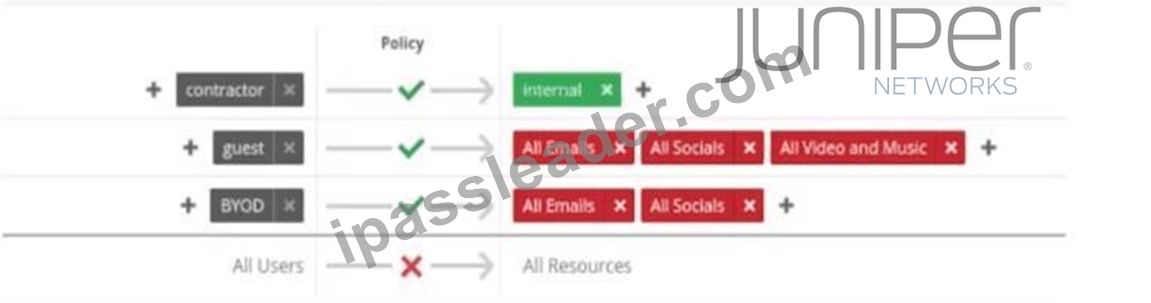
Your colleagues report that they are unable to browse tutorials needed for work located at youtube.com when using their BYOD devices. When using a guest device, they are able to access youtube.com.
In this scenario, how would you allow BYOD colleagues to access youtube.com using the WxLAN policies?
- A. Move the WxLAN policy for BYOD above the policy for guests.
- B. Delete the WxLAN policy for BYOD and add the BYOD label to the policy for guests.
- C. Move the WxLAN policy for guests above the policy for contractor.
- D. Delete the WxLAN policy for guests and add the guest label to the policy for BYOD.
Answer: A
Explanation:
InJuniper Networks Mist AI Wireless,WxLAN policiesare evaluated using atop-down, first-match logic.
This means that when traffic matches a policy condition, that policy is applied immediately, andno further policies are evaluated. Understanding this evaluation order is critical when troubleshooting access discrepancies between user types such as BYOD and guest users.
From the scenario and the exhibit, guest devices are able to accessyoutube.com, while BYOD devices are blocked. This indicates that:
* Theguest WxLAN policyallows "All Video and Music" traffic (which includes YouTube).
* TheBYOD WxLAN policyblocks "All Video and Music" traffic.
* The BYOD policy is evaluatedbeforethe guest policy.
Because BYOD users are matched to the BYOD label, their traffic hits the BYOD policy first and is denied before it can reach the more permissive guest policy. Simply modifying labels or deleting policies is unnecessary and could introduce unintended access control issues.
The correct and least disruptive solution is tomove the BYOD WxLAN policy above the guest policyand then adjust the BYOD policy rules (for example, allowing YouTube or the "All Video and Music" category).
By reordering the policies, you ensure that BYOD traffic is evaluated correctly and receives the intended permissions without impacting guest access.
The incorrect options are explained as follows:
* Deleting policies(Options A and C) is not best practice and risks breaking segmentation and access control.
* Option Bis irrelevant, as the contractor policy does not affect BYOD or guest traffic in this scenario.
Therefore, the correct solution is tomove the WxLAN policy for BYOD above the policy for guests, making Option Dthe correct answer.
NEW QUESTION # 29
The Marvis Actions dashboard displays a "Health Check Failed" action for a specific access point.
What does this indicate? (Select all that apply.)
- A. The AP is experiencing excessive RF interference.
- B. The AP is running a firmware version that is different from other APs of the same model at the site.
- C. The AP has detected a Layer 2 loop on its wired port.
- D. The AP's hardware is potentially faulty (e.g., high CPU, memory issues, or self-detected hardware errors).
- E. The AP has lost power.
Answer: D
NEW QUESTION # 30
A user complains that while their Wi-Fi connection is stable, application performance is very slow.
The administrator suspects a throughput issue.
Which SLE and corresponding classifier would best help diagnose if the problem is caused by the client's device being an old model with limited Wi-Fi capabilities?
- A. SLE: Coverage, Classifier: Weak Signal
- B. SLE: Successful Connects, Classifier: Association
- C. SLE: Capacity, Classifier: Client Count
- D. SLE: Throughput, Classifier: Device Capability
Answer: D
NEW QUESTION # 31
When building automation for a REST API, which protocol is used as the transport?
- A. HTTPS
- B. XML
- C. Python
- D. Ansible
Answer: A
Explanation:
In the architecture of Juniper Mist AI, the RESTful API is the foundational interface for all automation, monitoring, and configuration tasks.1 When building automation for a REST (Representational State Transfer) API, HTTPS (Hypertext Transfer Protocol Secure) is the protocol used as the transport mechanism. REST is an architectural style that leverages the existing standards of the web, and in the case of the Mist Cloud, it specifically mandates the use of HTTPS to ensure that all data transmitted between the automation script (the client) and the Mist Cloud (the server) is encrypted and secure.
HTTPS acts as the "delivery truck" for the API requests.2 It carries the HTTP methods-such as GET (to retrieve data), POST (to create new objects), PUT (to update existing ones), and DELETE (to remove them)
-across the network to specific Mist API endpoints (e.g., api.mist.com). While the actual data being transported is typically formatted in JSON (JavaScript Object Notation), the underlying protocol that handles the connection, session negotiation, and data encapsulation is HTTPS.
Mist's "100% API" philosophy means that every feature available in the GUI is accessible via these HTTPS- based calls.3 This allows developers to use various tools and languages to interact with the platform. For example, a developer might write a script in Python (C) or use an orchestration tool like Ansible (A), but both of these will ultimately generate HTTPS requests to communicate with the Mist backend. Similarly, while some older APIs used XML (B) for data structure, modern RESTful services like Mist exclusively use JSON for its lightweight and human-readable properties.4 Therefore, HTTPS remains the essential transport layer that enables the secure, stateless communication required for scalable cloud-native automation.
NEW QUESTION # 32
An administrator is configuring a new WLAN and wants to ensure that clients with very weak signals cannot connect, in order to protect airtime for other users. Which feature should be used to set a minimum RSSI threshold for initial client association?
- A. Client Inactivity Timeout
- B. Band Steering
- C. Data Rate Control
- D. Geofencing
Answer: D
NEW QUESTION # 33
A dynamic packet capture (dPCAP) is automatically triggered by the Mist system.
What is the most likely reason for this?
- A. A major network anomaly, such as a persistent authorization failure for a client, was detected.
- B. The AP has been offline for more than 10 minutes.
- C. The administrator manually requested a packet capture on an AP.
- D. A new client device has connected to the network for the first time.
Answer: A
NEW QUESTION # 34
Click the Exhibit button.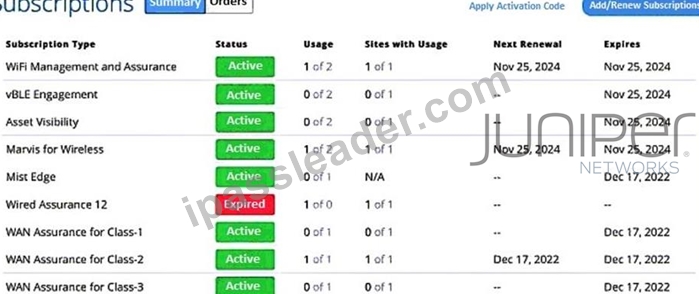
Referring to the exhibit, which two statements are correct? (Choose two.)
- A. The organization is using one license for Marvis wireless.
- B. The organization has two available licenses for Marvis wireless.
- C. The organization has one available license for Marvis wireless.
- D. The organization is using two licenses for Marvis wireless.
Answer: C,D
NEW QUESTION # 35
Referring to the WxLAN policy shown, which statement accurately describes the access rights for a user who has been assigned the "Contractor" role by the RADIUS server?
WxLAN Policy Rules:
1. User: 'Contractor' -> Resources: 'Public-Internet' -> Action: 'Allow'
2. User: 'Contractor' -> Resources: 'Internal-Servers' -> Action: 'Deny'
3. User: 'All Users' -> Resources: 'All Resources' -> Action: 'Deny
- A. The user can access the Internal Servers but not the Public Internet.
- B. The user cannot access any resources.
- C. The user can access both the Public Internet and the Internal Servers.
- D. The user can access the Public Internet but not the Internal Servers.
Answer: D
NEW QUESTION # 36
What is the purpose of the "Allowlist" in a WxLAN policy?
- A. To specify resources (like IP addresses or domains) that are always permitted, bypassing other block rules for a given user/role.
- B. To define which client devices are allowed to connect to the WLAN.
- C. To define a list of users who are exempt from all security rules.
- D. To list all the APs that the policy applies to.
Answer: A
NEW QUESTION # 37
What are basic data rates?
- A. fastest data rates
- B. required data rates
- C. disabled data rates
- D. optional data rates
Answer: B
NEW QUESTION # 38
For the Proximity Tracing LBS feature to work, what must be installed on the user's mobile device?
- A. A mobile SDK integrated into a partner application.
- B. A VPN client connecting to the Mist cloud.
- C. A special SIM card from Juniper.
- D. Nothing, it works automatically with any device.
Answer: A
NEW QUESTION # 39
What does Mist qualify as a rogue AP?
- A. A neighbor AP
- B. An unauthorized AP on your wired network
- C. An AP close to your network as measured by RSSI
- D. A honeypot AP
Answer: B
Explanation:
InJuniper Networks Mist AI Wireless, arogue access point (AP)is precisely defined to avoid confusion with external or non-threatening wireless devices. Mist qualifies a rogue AP asan unauthorized access point that is physically connected to your wired network infrastructure.
This distinction is critical from a security perspective. A rogue AP represents a direct threat because it bypasses established security controls by providing wireless access into the enterprise wired network without authorization. Such APs are often installed by users without IT approval or, in more serious cases, by malicious actors attempting to gain internal network access.
Mist APs continuously scan the RF environment and correlate wireless observations with wired-side intelligence. If an AP is detected advertising SSIDs and Mist can confirm-through MAC address correlation and wired discovery-that the device is connected to the enterprise's wired network but isnot claimed or authorized in the Mist cloud, it is classified as a rogue AP. This allows administrators to take immediate remediation actions, such as physical removal or switch-port shutdown.
The other options are incorrect for the following reasons:
* Neighbor APsare access points belonging to nearby organizations or environments and are not security threats by default. Mist classifies these separately for RF awareness.
* APs close to your network as measured by RSSImay simply be physically nearby but not connected to your infrastructure; proximity alone does not make an AP rogue.
* Honeypot APsare intentionally deployed decoy access points used in security research or attack detection and are not Mist's definition of a rogue AP.
Therefore, Mist correctly defines a rogue AP asan unauthorized AP connected to your wired network, making optionAthe correct answer.
NEW QUESTION # 40
What is a key benefit of using the Mist API for a large enterprise?
- A. It allows for the automation of repetitive tasks, such as creating multiple WLANs or onboarding new sites.
- B. It is the only way to configure APs.
- C. It provides a graphical interface for network management.
- D. It replaces the need for Wi-Fi Assurance subscriptions.
Answer: A
NEW QUESTION # 41
Which two terms correctly describe transmissions over Wi-Fi? (Choose two.)
- A. half-duplex
- B. point-to-point medium
- C. shared medium
- D. full-duplex
Answer: A,C
Explanation:
Transmissions over Wi-Fi are shared medium and half-duplex.
According to the IEEE 802.11 - Wikipedia document2, two terms that correctly describe transmissions over Wi-Fi are:
* Shared medium, which means that multiple devices use the same wireless channel and have to compete for access and avoid collisions.
* Half-duplex, which means that devices can either transmit or receive data at a time, but not both simultaneously.
References: https://en.wikipedia.org/wiki/IEEE_802.11
NEW QUESTION # 42
You are troubleshooting a client that has had intermittent connectivity problems. Using Marvis to troubleshoot, you see that AP uptime is negatively affecting the client.
When inspecting Marvis' troubleshooting response, which category should you select to see when the AP went offline?
- A. AP Metrics
- B. Location
- C. Classifiers
- D. Correlation
Answer: A
Explanation:
Reference: https://www.mist.com/documentation/metrics-on-the-access-points-page/
NEW QUESTION # 43
Which two statements are correct about channel bonding? (Choose two.)
- A. Bonding two channels together doubles the available bandwidth.
- B. Bonding two channels together doubles the noise floor.
- C. Bonding two channels together doubles the number of available channels.
- D. Bonding two channels together doubles the required device resources.
Answer: A,B
Explanation:
Reference: https://www.makeuseof.com/tag/internet-speed-channel-bonding/
NEW QUESTION # 44
Which Juniper AP is used to augment BLE coverage?
- A. AP242
- B. AP12
- C. BT111
- D. AP343
Answer: C
Explanation:
In the Juniper Mist AI product portfolio, the BT11 is a specialized, enterprise-grade access point designed exclusively for Bluetooth Low Energy (BLE).4 Unlike the other access points in the Juniper Mist family (such as the AP12, AP24, and AP34), the BT11 does not contain Wi-Fi radios.5 Its sole purpose is to provide high-accuracy, enterprise-grade location-based services (LBS) by leveraging Juniper's patented 16- element virtual BLE (vBLE) antenna array.6 The primary use case for the BT11 is to augment BLE coverage in environments where Wi-Fi connectivity is already established by other APs, but the density of those APs is insufficient for precise location services.
For applications like turn-by-turn wayfinding or asset tracking, the RF requirements for BLE are often more stringent than those for Wi-Fi. A facility might have enough Wi-Fi APs to provide data coverage, but may have "location holes" where the BLE signals are too sparse for 1-3 meter accuracy. By deploying BT11 units in these gaps, administrators can extend the reach of the location engine without the expense of adding full- featured Wi-Fi radios where additional capacity is not needed.7 The BT11 communicates directly with the Mist Cloud to manage virtual beacons, which eliminate the need for physical, battery-powered beacons and manual calibration.8 Because it runs on Power over Ethernet (PoE) and integrates seamlessly with the Mist AI engine, it provides a scalable and cost-effective way to ensure continuous, high-fidelity BLE coverage across a campus, hospital, or retail floor.
NEW QUESTION # 45
Which real-time location system component takes the coordinates of a tracked device and applies a location- aware triggered action to a client?
- A. Juniper Mist Edge
- B. Marvis Minis
- C. location system
- D. location sensor
Answer: C
Explanation:
In the architecture of a Mist AI Real-Time Location System (RTLS), the process of moving from raw signal data to an actionable event involves several distinct layers. To understand why the location system is the correct answer, we must examine how Mist processes Location-Based Services (LBS).
The workflow begins with location sensors (typically Mist Access Points). these sensors collect raw Bluetooth Low Energy (BLE) or Wi-Fi signals (RSS measurements) from tracked assets or mobile devices.
These raw data points are then transmitted to the cloud-based Mist AI engine. The location system (often referred to as the Location Engine within the Mist Cloud) is the specific functional component responsible for calculating the precise X/Y coordinates of the device using machine learning and trilateration algorithms.
However, its role does not end at mere coordinate calculation. The Mist location system is designed to be
"context-aware." Once the coordinates are established, the system maps these coordinates against defined zones, virtual beacons (vBeacons), or geofences configured in the Mist dashboard. When a device's coordinates intersect with a predefined boundary, the location system triggers a location-aware action. This could include sending a webhook to a third-party application, pushing a proximity notification to a mobile SDK client, or recording a "visit" in the analytics engine.
While Juniper Mist Edge handles data plane tunneling and Marvis Minis acts as a digital twin for network simulation, they do not manage the coordinate-to-action logic. The location system is the intelligence that bridges the gap between spatial data and business logic, ensuring that the right client receives the right trigger based on their physical presence within a venue.
NEW QUESTION # 46
A museum is deploying a user engagement application that provides visitors with information about exhibits as they walk through the galleries. The application uses the Mist Mobile SDK. To trigger content for a specific large exhibit, the administrator needs to define a precise polygonal area on the floorplan. When a user enters this defined area, the SDK should fire an event. Which LBS object should the administrator create on the floorplan to meet this requirement?
- A. A Wayfinding Path
- B. An Asset Filter
- C. A Proximity Zone
- D. A Location Zone
Answer: D
NEW QUESTION # 47
......
Reliable JNCIS MistAI Wireless JN0-452 Dumps PDF Jun 09, 2026 Recently Updated Questions: https://www.ipassleader.com/Juniper/JN0-452-practice-exam-dumps.html
Pass Your Juniper JN0-452 Exam with Correct 120 Questions and Answers: https://drive.google.com/open?id=1mR6zfOmZ_gs6hxub3hLL4VAAJIoC51Du