

[May 29, 2026] Ultimate NS0-593 Guide to Prepare Free Latest Network Appliance Practice Tests Dumps
Get Top-Rated Network Appliance NS0-593 Exam Dumps Now
Network Appliance NS0-593 certification exam is an essential certification for support engineers who work with NetApp ONTAP systems. NetApp Certified Support Engineer ONTAP Specialist certification validates the engineer's expertise in NetApp technologies and their ability to troubleshoot and resolve complex issues. Furthermore, it helps the engineer to gain recognition in the industry and differentiate themselves from their peers. NetApp Certified Support Engineer ONTAP Specialist certification also provides access to a wide range of resources, including technical support, training, and certification programs, which can help the engineer to enhance their skills and knowledge over time.
NEW QUESTION # 16
A 2-node cluster hosts only NAS data UFs. Allnodes lose access to the cluster network.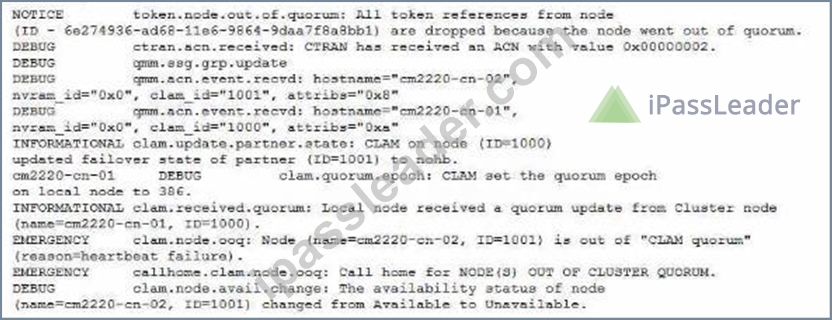
Referring to the exhibit, which statement is correct?
- A. NAS data UFs are accessible on only the node that has Epsilon.
- B. Both nodes race to takeover the other, one node will takeover the other node.
- C. No takeover event will occur and NAS data UFs will not be accessible.
- D. All nodes in the cluster reset and NAS data UFs are not accessible after reboot.
Answer: D
NEW QUESTION # 17
You receive the "Unable to connect to the management gateway server"error when trying to connect to a node
management IP.
In this situation, how do you determine whether core dumps are generated for the mgwd user space process?
- A. Log in to the clustershell using the node console and collect the core dumps from the clustershell.
- B. Log in to the service processor and collect the core dumps from the service processor.
- C. Log in to the nodeshell using the node console and collect the core dumps from the nodeshell.
- D. Log in to the systemshell and collect core dumps from thesystemshell.
Answer: B
NEW QUESTION # 18
You created a new NetApp ONTAP FlexGroup volume spanning six nodes and 12 aggregates with a total size of 4 TB. You added millions of files to the FlexGroup volume with a flat directory structure totaling 2 TB, and you receive an out of apace error message on your host.
What would cause this error?
- A. The maximum number of volume constituents has been reached in the ONTAP software.
- B. The maxdirsize Is exceeded in the ONTAP software.
- C. The inode limit is exceeded in the ONTAP software.
- D. All constituent volumes are full.
Answer: B
Explanation:
The maxdirsize is the maximum size of a directory in a FlexVol or FlexGroup volume. It is determined by the number of inodes allocated to the directory. If the directory contains more files than the maxdirsize can accommodate, then the ONTAP software will return an out of space error message to the host, even if the volume has enough free space. This can happen when a FlexGroup volume has a flat directory structure with millions of files, as the maxdirsize is not automatically adjusted for FlexGroup volumes12. Reference: 1: FlexGroup volumes: Frequently asked questions | NetApp Documentation 2: How to increase the maxdirsize of a FlexVol volume - NetApp Knowledge Base
NEW QUESTION # 19
Refer to the exhibit.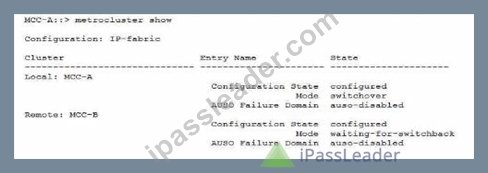
Referring to the exhibit, what do you need to do to return the MetroCluster to a normal state?
- A. Enter the storage failover giveback command on Site A.
- B. Enter the storage failover giveback command on Site B.
- C. Enter the metroclustor switchback command on Site B.
- D. Enter the metrocluster switchback command on Site A.
Answer: D
Explanation:
The question refers to a MetroCluster configuration, which is a disaster recovery solution that uses two physically separated, mirrored clusters1.
The exhibit shows a MetroCluster switchover scenario, where Site A has experienced a disaster and Site B has taken over the tasks of Site A2.
To return the MetroCluster to a normal state, you need to perform a MetroCluster switchback operation, which reverses the switchover and activates the original sync-source storage virtual machines (SVMs) on Site A3.
To perform a MetroCluster switchback, you need to enter the metrocluster switchback command on the cluster that was the source of the switchover, which is Site A in this case3.
The other options are not correct, because:
A) Entering the metrocluster switchback command on Site B will not work, as Site B is the destination of the switchover, not the source3.
C) Entering the storage failover giveback command on Site B will not work, as this command is used for local HA failover within a cluster, not for MetroCluster switchover between clusters4.
D) Entering the storage failover giveback command on Site A will not work, as this command is used for local HA failover within a cluster, not for MetroCluster switchover between clusters4. Reference:
Understanding MetroCluster data protection and disaster recovery - NetApp Perform IP MetroCluster switchover and switchback - NetApp Performing a switchback - NetApp High-availability configuration - NetApp
NEW QUESTION # 20
Your customer calls you because one application is not able to access a NetApp ONTAP S3 bucket. While
reviewing the EMS log on the cluster, you see the following message:
The same credentials work in another application.
In this scenario, what would cause this problem?
- A. The application is trying to log in as an anonymous user.
- B. The application is using v4 signatures.
- C. The application is using v2 signatures.
- D. The application is trying to access using the HTTP protocol.
Answer: A
NEW QUESTION # 21
You have a 4-node NetApp ONTAP 9.8 cluster with an AFF A400 HA pair and a FAS8300 HA pair with 16 TB NL-SAS drives. You are asked to automatically tier 150 TB of Snapshot copy data from the AFF A400 aggregates to the FAS8300.
In this scenario, which ONTAP license must be added to the cluster to accomplish this task?
- A. FabricPool license
- B. TPM license
- C. VE license
- D. S3 license
Answer: A
NEW QUESTION # 22
A customer enabled NFSv4.0 on an SVM and changed the client mount from NFSv3 to NFSv4. Afterwards, the customer found that the directory owner was changed from root to nobody.
In this scenario, which statement is true?
- A. The export policy is not configured properly.
- B. The customer did not configure name services on the SVM.
- C. The clients must be restarted to start using NFSv4.
- D. The ID mapping domains do not match between the client and server.
Answer: D
Explanation:
NFSv4 is a network file system protocol that supports security, performance, and scalability features. NFSv4 uses ID mapping to ensure that the permissions of files and directories are consistent across different NFSv4 servers and clients1 ID mapping is the process of translating the user and group identifiers (UIDs and GIDs) of the local system to the user and group names (user@domain and group@domain) of the remote system, and vice versa. ID mapping is done by the idmapd service, which uses the /etc/idmapd.conf file to determine the domain name of the system2 ID mapping requires that the NFSv4 server and client have the same domain name configured in the /etc/idmapd.conf file. If the domain names do not match, the idmapd service cannot map the UIDs and GIDs to the user and group names, and the permissions of the files and directories will be shown as nobody:nobody, which is the default anonymous user3 Therefore, if a customer enabled NFSv4.0 on an SVM and changed the client mount from NFSv3 to NFSv4, and found that the directory owner was changed from root to nobody, the most likely cause is that the ID mapping domains do not match between the client and server. The customer should check and correct the /etc/idmapd.conf file on both systems, and restart the idmapd service and remount the NFSv4 share4 Reference:
1: ONTAP 9 - Network File System (NFS) - The Open Group 2: ONTAP 9 - NFSv4 and NFSv4.1 Enhancements - The Open Group 3: NFSv4 mount incorrectly shows all files with ownership as nobody:nobody - Red Hat Customer Portal 4: NFSv4 mountpoint shows incorrect ownerships as nobody:nobody in CentOS/RHEL - The Geek Diary
NEW QUESTION # 23
Which two statements about NetApp Cloud Volumes ONTAP licenses ate true? (Choose two.)
- A. AWS Marketplace contracts cannot be mixed with BYOL.
- B. Capacity-based license packages support only single-node configurations.
- C. BYOL licenses are purchased directly from NetApp.
- D. Having an Essentials package enables you to convert to another licensing option.
Answer: C,D
Explanation:
Having an Essentials package enables you to convert to another licensing option. This is true because the Essentials package is a capacity-based licensing option that allows you to pay for Cloud Volumes ONTAP per TiB of capacity. You can switch to another capacity-based package or to a Keystone Flex Subscription at any time1.
BYOL licenses are purchased directly from NetApp. This is true because BYOL stands for Bring Your Own License, which means you need to obtain a license from NetApp before deploying Cloud Volumes ONTAP systems in any cloud provider2.
Capacity-based license packages support only single-node configurations. This is false because capacity-based license packages support both single-node and HA configurations1.
AWS Marketplace contracts cannot be mixed with BYOL. This is false because you can mix AWS Marketplace contracts with BYOL as long as the license type matches the instance type3. Reference: 1: Cloud Volumes ONTAP licensing | NetApp Documentation 2: Set up licensing for Cloud Volumes ONTAP in Google Cloud - NetApp 3: Set up licensing for Cloud Volumes ONTAP in AWS - NetApp
NEW QUESTION # 24
You are deploying NetApp ONTAP Select. When trying to add VMware vCenter to the inventory, you receive
the message shown below.
Credential authentication failed for x.x.x.x with: HostConnectionFailed
In this scenario, how would you correct this problem?
- A. Change the IP address of the ONTAP Select Deploy VM.
- B. Change the vCenter password.
- C. Change the gateway address of the ONTAP Select Deploy VM.
- D. Change the IP address of the vCenter server.
Answer: B
NEW QUESTION # 25
A user reports that a colleague saved a file called Test.txt from a UNIX system to a multiprotocol volume. When opening the file later from a Windows system, it was not the file that they wanted. The file that they wanted was named TEST~1.TXT.
Which statement explains this behavior?
- A. A Snapshot copy preserved two versions of the file.
- B. Case Insensitivity of SMB clients caused the file to be displayed with a different name.
- C. UNIX name mapping updated the filename.
- D. Windows Volume Shadow Copy Service stored an older version of the file.
Answer: B
Explanation:
= The multiprotocol volume allows clients to access files using both NFS and SMB protocols. The NFS protocol is case-sensitive, meaning that Test.txt and TEST~1.TXT are two different files. The SMB protocol is case-insensitive, meaning that it treats uppercase and lowercase letters as the same when searching for a file. Therefore, when the user opened the file from a Windows system using SMB, the system could not distinguish between Test.txt and TEST~1.TXT and displayed one of them arbitrarily. This could lead to confusion and data loss if the user modified or deleted the wrong file. Reference = Client protocols; Multiprotocol NAS in NetApp ONTAP Overview and Best Practices, page 30-31.
NEW QUESTION # 26
Your customer mentions that they have accidentally destroyed both root aggregates in their two-node cluster.
In this scenario, what are two actions that must be performed? (Choose two.)
- A. Install ONTAP from a USB device.
- B. Re-create the cluster from the local backup.
- C. Re-create the cluster from the remote backup.
- D. Rejoin the second node to the re-created cluster.
Answer: A,D
Explanation:
If both root aggregates are destroyed in a two-node cluster, the cluster will be inoperable and the data will be inaccessible. To recover from this situation, you need to perform the following actions:
Install ONTAP from a USB device on one of the nodes. This will create a new root aggregate and a new cluster on that node.
Rejoin the second node to the re-created cluster. This will also create a new root aggregate on the second node and synchronize it with the first node.
Restore the cluster configuration and data from a backup, if available. Reference = ONTAP 9 Documentation Center Storage System Recovery Troubleshooting Recovering from a root aggregate failure
NEW QUESTION # 27
You are attempting to connect a NetApp ONTAP cluster to a very complex network that requires LIFs to fail
over across subnets.
How would youaccomplish this task?
- A. Configure VIP LIFs using OSPF.
- B. Configure an equal number of UFs on each subnet.
- C. Configure a I IF failover policy for each subnet inside a single broadcast domain.
- D. Configure VIP LIFs using BGP.
Answer: D
NEW QUESTION # 28
An administrator receives the following error message:
What are two causes for this error? (Choose two.)
- A. A disk is falling.
- B. There Is excessive SSD load causing the wear leveling to become unbalanced.
- C. An SSD disk is performing garbage collection to create a dense data layout.
- D. There is excessive SATA HDD load.
Answer: B,D
NEW QUESTION # 29
After expanding a two-node AFF A300 cluster with two AFF A700 nodes, you observe latencies when data is accessed indirectly. The system node run -node -command netstat command shows retransmits and packet drops on the LIFs. The AFF A700 nodes with 40 Gbps and the AFF A300 connect with 10 Gbps to the cluster interconnect. You are using Cisco Nexus 3132Q cluster interconnect switches. You just updated to ONTAP 9.8 software.
In this scenario, what is causing this problem?
- A. The AFF A300 Is using an adapter card for the cluster Interconnect, but only onboard ports are supported.
- B. AFF A300 and AFF A700 node mixing Is not supported in ONTAP 9.8 software.
- C. The 10 Gbps to 10 Gbps cluster Interconnect is creating a speed mismatch.
- D. There is an NXOS firmware mismatch, verify in the Interoperability Matrix (1MTJ for a supported version.
Answer: C
Explanation:
A speed mismatch occurs when the cluster ports on different nodes have different speeds, such as 10 Gbps and 40 Gbps1.
A speed mismatch can cause packet loss, retransmits, and latency on the cluster network, especially when data is accessed indirectly, meaning that the node serving the data is different from the node hosting the LIF2.
In this scenario, the AFF A300 nodes have 10 Gbps cluster ports, while the AFF A700 nodes have 40 Gbps cluster ports, creating a speed mismatch on the cluster interconnect34.
The Cisco Nexus 3132Q cluster interconnect switches support both 10 Gbps and 40 Gbps cluster ports, but they have a shallow buffer size of 9 MB per port, which can be easily overwhelmed by the bursty traffic generated by the speed mismatch.
To solve this problem, you need to either upgrade the cluster ports on the AFF A300 nodes to 40 Gbps, or downgrade the cluster ports on the AFF A700 nodes to 10 Gbps, to achieve a homogeneous cluster interconnect1.
Alternatively, you can use QoS policies to limit the bandwidth of the cluster ports to avoid oversubscription and congestion on the cluster interconnect. Reference:
1: Cluster network cabling, ONTAP 9 Documentation Center
2: Cluster Network Latency - Troubleshooting Guide, NetApp Knowledge Base
3: AFF A300 Tech Specs, NetApp
4: AFF A700 Tech Specs, NetApp
[5]: Why do network speed mismatches create problems with shallow buffered switches?, NetApp Knowledge Base
[6]: How to use QoS to limit the bandwidth of cluster ports, NetApp Knowledge Base
NEW QUESTION # 30
A user reports that a colleague saved a file called Test.txt from a UNIX system to a multiprotocol volume.
When opening the file later from a Windows system, it was not the file that they wanted. The file that they
wanted was named TEST~1.TXT.
Which statement explains this behavior?
- A. A Snapshot copy preserved two versions of the file.
- B. UNIX name mapping updated the filename.
- C. Case Insensitivity of SMB clients caused the file to be displayed with a different name.
- D. Windows Volume Shadow Copy Service stored an older version of the file.
Answer: A
NEW QUESTION # 31
You are troubleshooting a CIFS connection issue that is reported by some users. You decide to collect a packet trace.
In this scenario, after you generate the packet trace, where do you find the trace file?
- A. /etc/log/packet_traces of the node hosting the LIF
- B. /packet_traces of the node hosting the LIF
- C. /vol0/paclcet_traces of the CIFS SVM
- D. /etc/log/mlog/packet._traces Of all nodes
Answer: A
Explanation:
According to the NetApp Knowledge Base, packet traces are stored in the /etc/log/packet_traces directory of the node hosting the LIF. This applies to ONTAP 9.10 and above systems. For ONTAP 9.2 to 9.9 systems, the procedure to capture packet traces is similar, but the command syntax is slightly different. For ONTAP pre-9.2 systems, the procedure is different and requires the use of the tcpdump command. Reference = How to capture packet traces on ONTAP 9.10+ systems, How to capture packet traces (tcpdump) on ONTAP 9.2 to 9.9 systems, How to capture packet traces in ONTAP pre-9.2
NEW QUESTION # 32
You are deploying NetApp ONTAP Select. When trying to add VMware vCenter to the inventory, you receive the message shown below.
Credential authentication failed for x.x.x.x with: HostConnectionFailed In this scenario, how would you correct this problem?
- A. Change the gateway address of the ONTAP Select Deploy VM.
- B. Change the IP address of the ONTAP Select Deploy VM.
- C. Change the IP address of the vCenter server.
- D. Change the vCenter password.
Answer: B
Explanation:
The error message indicates that the ONTAP Select Deploy VM cannot connect to the vCenter server due to a network issue1.
One possible cause of this issue is that the IP address of the ONTAP Select Deploy VM is conflicting with another device on the same network2.
To correct this problem, you need to change the IP address of the ONTAP Select Deploy VM to a unique and valid address that can reach the vCenter server2.
You can change the IP address of the ONTAP Select Deploy VM by using the Deploy web interface or the Deploy CLI2.
After changing the IP address, you need to restart the Deploy services and re-add the vCenter server to the inventory2. Reference:
1: Credential authentication failed with: HostConnectionFailed, NetApp Knowledge Base
2: Changing the IP address of the Deploy VM, ONTAP Select 9 Documentation Center
NEW QUESTION # 33
After users start reporting the Inability to create new flies in a CIFS share, you find EMS events for wafl.dir.size.max logged for the volume of the SVM to which the share points.
In this scenario, which action should you take to solve this issue?
- A. Delete unneeded files from the directory.
- B. Increase the maximum directory size for the volume.
- C. Move the volume to a different aggregate.
- D. Increase the maximum number of files for the volume.
Answer: B
Explanation:
The wafl.dir.size.max event occurs when a directory has reached its maximum directory size (maxdirsize) limit, which prevents new file creation in that directory. The maxdirsize is a volume-level option that can be modified using the volume modify command. To solve this issue, you should increase the maximum directory size for the volume that contains the CIFS share, as long as it does not exceed 3% of the physical memory. Alternatively, you can reorganize the directory structure to avoid having too many files in one directory. Reference = Max Directory size error - NetApp Knowledge Base How to identify the target directory of wafl.dir.size.warning - NetApp Knowledge Base Post about wafl.dir.size.max | Source.kohlerville.com WAFL Max dirsize | uadmin
NEW QUESTION # 34
The motherboard of Node-01 is being replaced. To perform this task, a takeover was Initiated from Node-02.
Node-02 panics showing the string below.
PANIC; Permanent errors on all HA mailbox disks (while marshalling header) in SKprocess
fnmbx_instanceWorker on release 9.5P8 (C)
What has happened in this situation?
- A. While in maintenance mode, the HA_config show command was executed.
- B. While in maintenance mode, the mailbox destroy local command was executed.
- C. While in maintenance mode, the fcadmin device_map command was executed.
- D. While in maintenance mode, the sldiag device show command was executed.
Answer: C
NEW QUESTION # 35
You ate connecting a Windows Server 2019 host to ISCSI LUNs on a 4-node AFF A250 cluster running NetApp ONIAP 9.8 software. The host is unable to connect to the target interface, and the ONTAP event log has the message shown below.
ISCSI: network interface identifier disabled for use; incoming connection discarded In this scenario, what is the cause of this connection issue?
- A. The iSCSI service is not enabled on the interface.
- B. iSNS is not enabled on the storage virtual machine.
- C. CHAP is not configured correctly for the specified initiator.
- D. The WWPN was not added to the initiator group.
Answer: A
Explanation:
The iSCSI service must be enabled on the network interfaces that are used for iSCSI communication. If the iSCSI service is disabled on an interface, the incoming connection requests from the iSCSI initiator will be discarded and the event log will show the message "ISCSI: network interface identifier disabled for use; incoming connection discarded". To enable the iSCSI service on an interface, you can use the System Manager or the CLI command network interface modify -vserver vserver_name -lif lif_name -data-protocol iscsi. Reference = Configure the iSCSI protocol with System Manager, [ONTAP 9 Network Management Guide]
NEW QUESTION # 36
You receive the panic message shown in the exhibit.
In this scenario, which component should you troubleshoot first?
- A. the MetroCluster FC-Vl card in slot 6
- B. the CPU
- C. the memory module in slot 1
- D. the PCI card in slot 3
Answer: B
NEW QUESTION # 37
A system panic due to an "L2 watchdog timeout hard reset" error occurred. You have found a FIFO message
in the SP log.
Which FIFO message Is useful for Investigating this Issue?
- A. before Reset BBSP:C=00 L=00 FIFO:
- B. BIOS exit BBSP:C=2F L=20 FIFO: 2 C8 C9 C4 24 4 6 18 7 8 11
- C. ONTAP Shutdown BBSP:C=00 L=2F FIFO:
- D. before NMI BBSP:C=00 L=00 FIFO: F3 F2 F1 F0 5 B2 0 0 0 80 20 E F E3 C0 C2 3 4 6 7 9 9 A
Answer: B
NEW QUESTION # 38 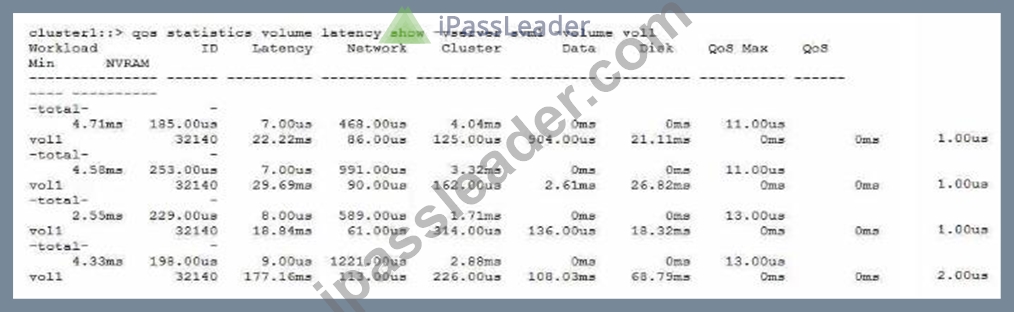
Referring to the exhibit, from which delay center is most of the latency for voll?
- A. NVRAM
- B. Network
- C. Data
- D. Disk
Answer: B
NEW QUESTION # 39
......
Passing Key To Getting NS0-593 Certified Exam Engine PDF: https://www.ipassleader.com/NetworkAppliance/NS0-593-practice-exam-dumps.html
NS0-593 Exam Dumps Pass with Updated Tests Dumps: https://drive.google.com/open?id=1qYqCxyMHqB9AepdsDc54m7SCn62taSph