

Enhance your career with JN0-223 PDF Dumps - True Juniper Exam Questions
New (2025) Download free JN0-223 PDF for Juniper Practice Tests
Juniper JN0-223 (Automation and DevOps, Associate (JNCIA-DevOps)) Exam is a certification exam that is designed to test the knowledge and skills of individuals who are interested in automation and DevOps. JN0-223 exam covers various topics such as automation tools and technologies, DevOps methodologies, and scripting languages. Automation and DevOps, Associate (JNCIA-DevOps) certification is ideal for individuals who are looking to advance their careers in automation and DevOps.
Juniper JN0-223, also known as the Automation and DevOps Associate (JNCIA-DevOps), is a certification exam for IT professionals who want to develop knowledge and skills in automation and DevOps. JN0-223 exam is designed to test the knowledge and skills required to develop, test, deploy, and monitor automation solutions using Juniper Networks' platforms and tools.
The JN0-223 certification exam is a computer-based test that consists of 65 multiple-choice questions. JN0-223 exam duration is 90 minutes, and the passing score is 65%. JN0-223 exam is available in multiple languages, including English, Japanese, and Simplified Chinese. JN0-223 exam registration fee is $200, and candidates can take the exam at any Pearson VUE testing center.
NEW QUESTION # 17
Junos supports which two APIs for on-box scripting? (Choose two.)
- A. Chef
- B. Puppet
- C. XML
- D. JET
Answer: C,D
Explanation:
Juniper Networks' Junos operating system supports several APIs for on-box scripting, two of which are:
* JET (Juniper Extension Toolkit): JET is a modern API framework that provides a programmable interface for interacting with Junos. It allows developers to create custom applications that run directly on Junos devices, enabling the automation of network operations. JET provides both a gRPC and a REST API interface, allowing for flexible integration with external systems.
* XML API: The Junos XML API allows direct interaction with the Junos OS through XML-based requests. This API can be used to retrieve information, configure devices, and execute commands on Junos devices. The XML API is crucial for automation tasks as it provides a structured and consistent way to interact with the device's configuration and operational data.
* JET (A)provides high-performance access to Junos routing, switching, and service elements via programmable interfaces. It is highly used for creating custom applications that require tight integration with the Junos OS.
* XML (C), on the other hand, is a well-established method for interacting with Junos, especially for legacy systems or when working within environments where XML is the standard data format.
Detailed Explanation:Other options like Puppet (B) and Chef (D) are not APIs provided by Junos for on- box scripting but are configuration management tools used externally to manage Junos devices.
* Juniper Networks JET Documentation: Provides details on how to leverage JET APIs for automation.
* Junos XML Management Protocol Guide: Describes how to use XML for scripting and automating tasks in Junos.
References:These APIs are key components of Juniper's automation strategy, allowing for scalable, flexible, and efficient network operations.
NEW QUESTION # 18
Which statement is valid regarding YAML and JSON?
- A. White space is ignored in YAML and JSON.
- B. YAML and JSON use indentation.
- C. YAML and JSON are case-sensitive.
- D. Comments are available in YAML and JSON.
Answer: C
Explanation:
Both YAML and JSON are case-sensitive, meaning that the distinction between uppercase and lowercase characters matters. For example, in JSON or YAML, Key and key would be considered different.
Option D (case-sensitive) is correct because both YAML and JSON treat keys and values with different cases as distinct.
Option A is incorrect because, while JSON does not use indentation, YAML does rely on indentation to define structure. Option B is incorrect because whitespace can be significant in YAML for structure, and Option C is incorrect because JSON does not support comments, while YAML does.
Supporting Reference:
YAML and JSON Documentation: The official specifications for both YAML and JSON emphasize their case sensitivity.
NEW QUESTION # 19
Which statement is correct about DevOps?
- A. DevOps is a collection of strict guidelines that promotes the project completion over all other aspects.
- B. DevOps is meant to unite the development, operations, and other teams to improve project collaborations.
- C. DevOps is a defined standard written and maintained by the IEEE standards group.
- D. DevOps is meant to define and restrict the development and operations tools used for a project.
Answer: B
Explanation:
DevOps is a set of practices, tools, and cultural philosophies that aims to integrate and automate the processes between software development and IT operations teams. The primary goal of DevOps is to shorten the systems development life cycle and provide continuous delivery with high software quality.
Option C is correct because DevOps fundamentally focuses on breaking down the silos between development and operations teams, fostering a collaborative environment where these teams work together throughout the entire software lifecycle. This collaboration extends to other stakeholders, including quality assurance (QA), security, and more, to ensure that the product is continuously delivered and improved based on real-time feedback.
DevOps promotes a cultural shift where teams are no longer isolated but work together to share responsibilities, which leads to increased efficiency, faster problem resolution, and a more streamlined deployment process. This culture of collaboration is supported by various automation tools and practices such as Continuous Integration (CI), Continuous Deployment (CD), Infrastructure as Code (IaC), and automated testing.
Supporting Reference:
Juniper Networks Automation and DevOps Documentation: This documentation emphasizes the importance of collaboration between development and operations teams to streamline processes and improve efficiency, aligning perfectly with the principles of DevOps.
"The DevOps Handbook" by Gene Kim, Patrick Debois, John Willis, and Jez Humble: This book provides an in-depth look into how DevOps practices enhance collaboration and lead to faster, more reliable software delivery.
IEEE and Industry Standards: While DevOps practices are widely adopted, they are not defined or maintained by IEEE or any other formal standards body, which is why option D is incorrect.
NEW QUESTION # 20
Exhibit.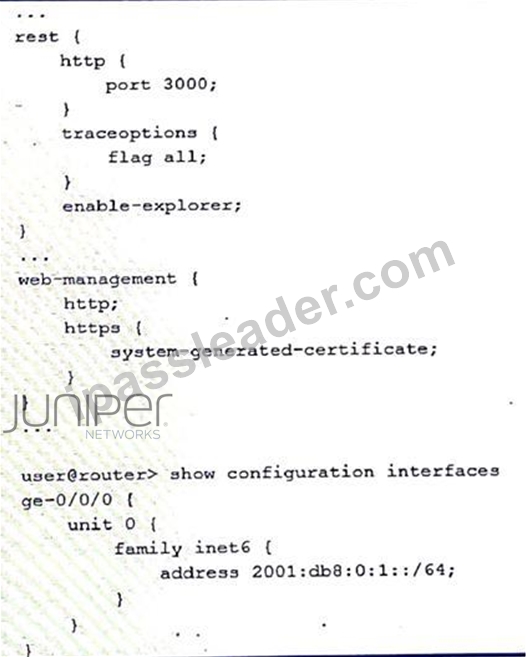
You have the configuration shown in the exhibit, but are unable to access the REST API Explorer.
Which configuration is necessary to solve this problem?
- A. Configure a secondary IPv6 address on ge-0/0/0.0.
- B. Configure an IPv4 address on ge-0/0/0 0.
- C. Configure the rest service to be active on port 80.
- D. Configure a firewall filter to explicitly permit SSH.
Answer: A
NEW QUESTION # 21
Exhibit.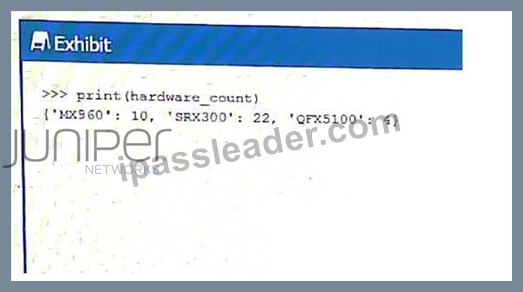
Referring to the exhibit, what is the correct method to retrieve the value associated only with
''MX960''?
- A. hardware_count. value ()
- B. hardware_count (0)
- C. harware_count [''MX960'']
- D. hardware_count.keys ()
Answer: D
NEW QUESTION # 22
Which two processes are used by Junos automation? (Choose two.)
- A. jsd
- B. kmd
- C. ifd
- D. mod
Answer: A,B
Explanation:
Junos automation relies on several key processes to handle various automation and API interactions. Let's break down the two key processes involved:
jsd (Junos Script Daemon):
The jsd process is responsible for handling automation scripts, including Python and SLAX scripts, as well as handling JET (Junos Extension Toolkit) API requests. This process is fundamental in the automation framework of Junos, as it deals with external and internal API requests, ensuring that the necessary scripts are executed when specific triggers or events occur.
kmd (Key Management Daemon):
The kmd process is involved in key management for IPsec and other security services. While its primary function is related to managing cryptographic keys, it plays a role in Junos automation by enabling secure communication and ensuring that automation tasks involving security services (such as automated IPsec tunnel creation) are handled securely.
Why the Other Options Are Incorrect:
A . mod: This process doesn't exist as part of the Junos automation framework. It's likely a distractor.
C . ifd: The ifd process is associated with the physical interfaces on the device and does not play a role in automation or script processing.
Reference from Juniper Documentation:
Junos Automation Processes
NEW QUESTION # 23
Which two statements are correct about a Python dictionary data type? (Choose two.)
- A. The data stored in a dictionary data type is sequenced and indexed.
- B. The data contained in a dictionary data type cannot be removed once the dictionary has been created.
- C. The data stored in a dictionary data type is not sequenced or indexed.
- D. The data contained in a dictionary data type is a key/value pair.
Answer: C,D
Explanation:
A Python dictionary is a data type that stores data in the form of key/value pairs. It has the following characteristics:
Key/Value Pair (C): Each entry in a dictionary is a pair consisting of a unique key and a value. The key is used to access the corresponding value.
Not Sequenced or Indexed (D): Unlike lists or tuples, dictionaries do not maintain order for their entries (in versions prior to Python 3.7). Even though Python 3.7+ maintains insertion order, dictionaries are not considered indexed or sequenced in the traditional sense like lists, where elements are accessed via positional index.
Option A is incorrect because dictionary entries can be added, modified, or removed after the dictionary is created. Option B is incorrect because dictionaries are not accessed by a numeric index but rather by their keys.
Reference:
Python Official Documentation: Details the nature of dictionaries, including their mutability and key/value structure.
Python Data Structures Guide: Explains dictionary operations and characteristics.
NEW QUESTION # 24
Using the set rest control configuration command, what are two ways to control access to the REST API running on a Junos device? (Choose two.)
- A. Limit access to only certain source IP addresses
- B. Limit the number of simultaneous connections.
- C. Limit management access to only SSH
- D. Limit management access to specific users.
Answer: A,B
Explanation:
When using theset rest control configurationcommand on a Junos device, you have several options to control access to the REST API. Two effective methods include:
* Limiting the number of simultaneous connections:This ensures that the REST API is not overwhelmed by too many concurrent requests, which could potentially lead to performance issues or denial of service.
* Limiting access to certain source IP addresses:This method restricts API access to specific IP addresses, enhancing security by ensuring that only trusted sources can interact with the REST API.
* Option A (Limit management access to only SSH)is unrelated to controlling REST API access specifically.
* Option B (Limit management access to specific users)might be relevant in a different context, but it is not directly tied to REST API control via the specific command mentioned.
Supporting References:
* Juniper Networks REST API Documentation:This documentation explains how to configure and control access to the REST API on Junos devices, including connection limits and IP-based access control.
NEW QUESTION # 25
Exhibit.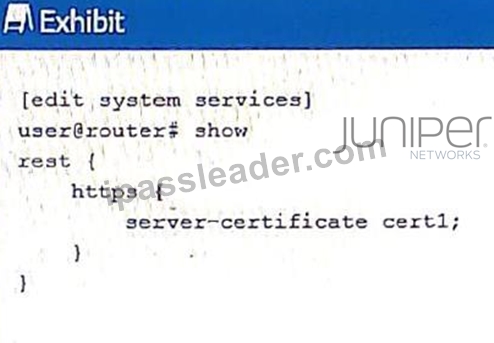
Referring to the exhibit, which statement about REST is correct?
- A. The device is configured to allow connections from the REST API Explorer
- B. The device is configured to allow HTTP connections on port 3030.
- C. The device is configured to allow only two simultaneous REST connections.
- D. The device is configured to allow HTTPS connections on port 3443.
Answer: D
NEW QUESTION # 26
Exhibit.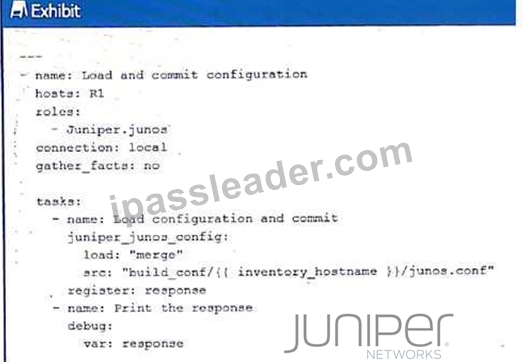
Referring to the exhibit, where would the junos. conf file be found?
- A. a directory on juniper__}uno3_conf
- B. a directory located on R1
- C. a local directory on the Ansible control machine
- D. a directory on the device list in inventory_hostname
Answer: C
NEW QUESTION # 27
Which two processes does Junos automation use? (Choose two.)
- A. jsd
- B. chassisd
- C. mgd
- D. dcd
Answer: A,C
Explanation:
Reference: https://coggle.it/diagram/XW0atWn5-1ccZJer/t/junos-automation-stack
NEW QUESTION # 28
Exhibit.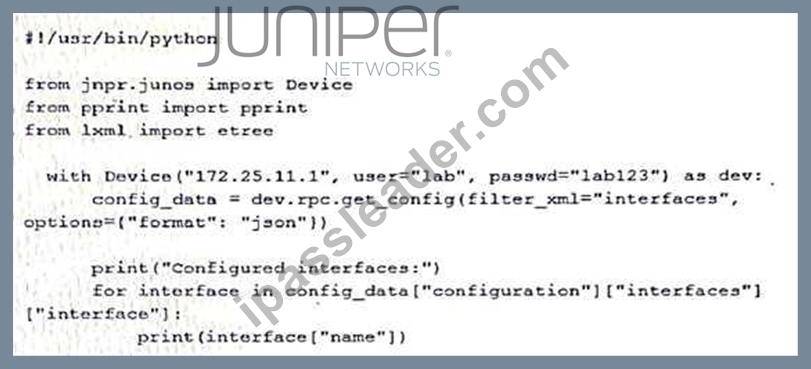
Referring to the exhibit, which two statements about the script are correct? (Choose two.)
- A. The script prints the name of each configured interface.
- B. The script retrieves the interface configuration in XML
- C. The script prints interface information for each interface name.
- D. The script retrieves the interface configuration in JSON.
Answer: A,D
NEW QUESTION # 29
Exhibit.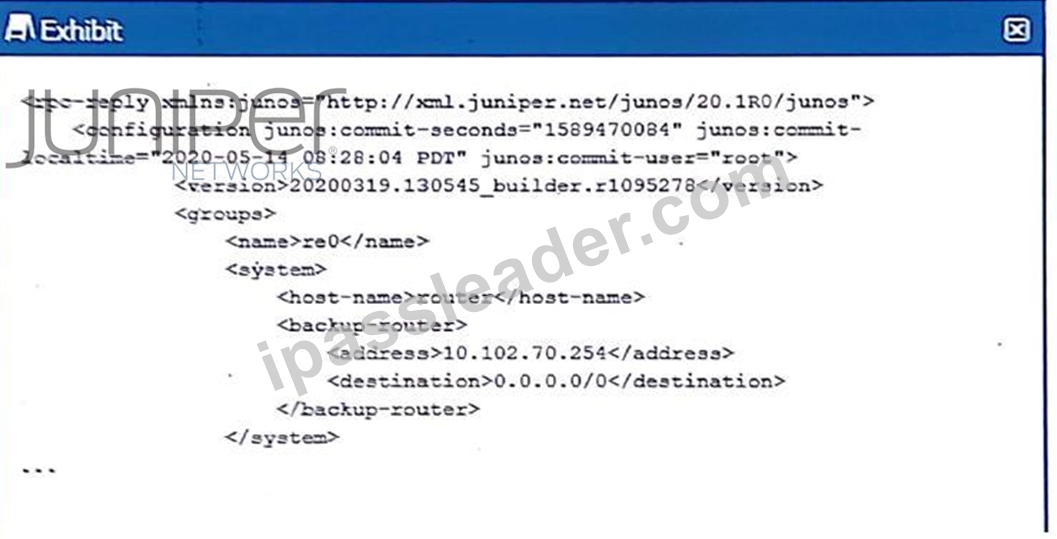
Referring to the exhibit, which XPath statement would retrieve the commit-user attribute in the candidate configuration?
- A. configuration/commit-user
- B. configuration/@ junos: commit-user
- C. configuration/junos: commit-user
- D. configuration:@ junos: commit-user
Answer: D
NEW QUESTION # 30
What is an example of correct XML syntax?
- A. <Device3><ho3tname>vMX1</hostname><Devices/>
- B. <Devices><hostname>vMX1<Devices/>
- C. <Devices><hostname>vMX1</ho3tnameX/Device3>
- D. <Devices><hostname>vMX1<De vices/X/hostname>
Answer: D
NEW QUESTION # 31
You want to use a Python package or module.
In this scenario, which statement would accomplish this task?
- A. Import
- B. dir
- C. reap
- D. input
Answer: A
Explanation:
In Python, to use a package or module, you use theimportstatement. This statement allows you to load a module into your script so that you can use its functions, classes, and variables. For example, if you wanted to use themathmodule, you would writeimport math. This makes all the functions and constants in themathmodule available for use in your program.
* Option A (reap), B (dir), and C (input)do not serve the purpose of importing modules.diris used to list the attributes of an object,inputis used to get user input, andreapis not a valid Python command related to importing modules.
Supporting References:
* Python Documentation on Imports:The Python documentation provides clear guidelines on how to use theimportstatement to include modules in your Python scripts.
NEW QUESTION # 32
Exhibit.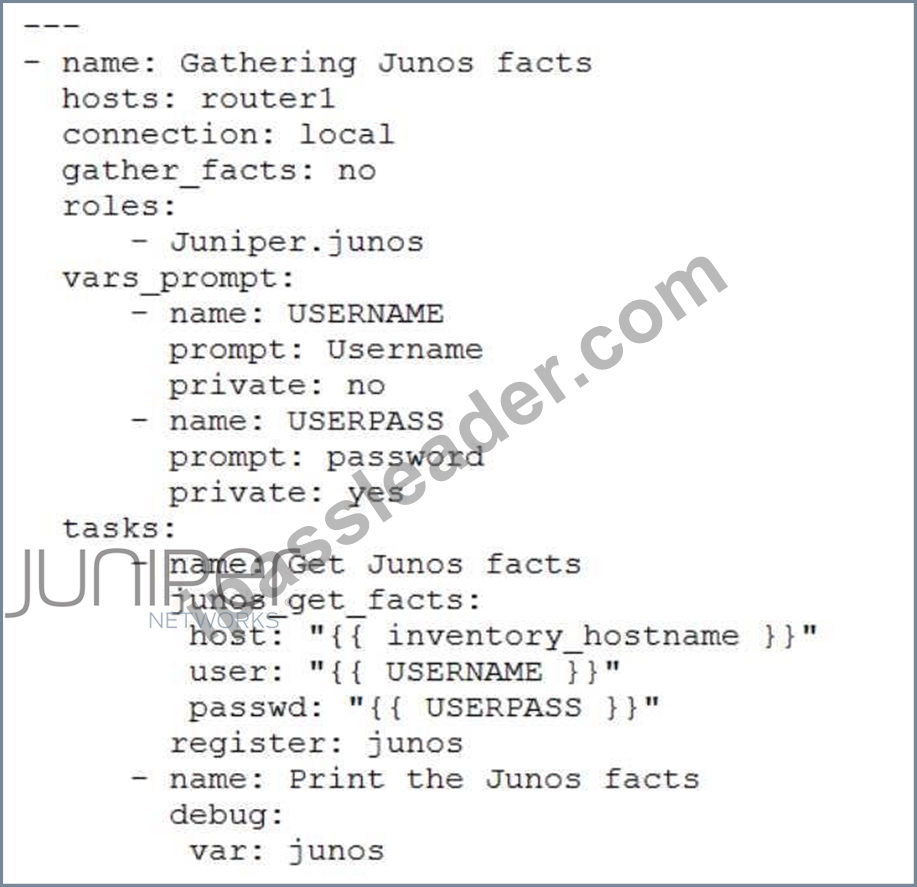
Which type of file is shown in the exhibit?
- A. Puppet manifest
- B. XSLT file
- C. Ansible playbook
- D. XML file
Answer: C
NEW QUESTION # 33
Which Python operator is used to test if two variables are equal?
- A. =
- B. !=
- C. ==
- D. %
Answer: C
Explanation:
In Python, the == operator is used to test whether two variables are equal. It returns True if the variables are equal and False if they are not.
Option B (==) is correct because it is the equality operator in Python.
Option A (!=) is used for inequality, Option C (%) is the modulus operator, and Option D (=) is used for assignment, not for testing equality.
Supporting Reference:
Python Documentation on Operators: The official Python documentation covers the use of == for equality checks.
NEW QUESTION # 34
......
100% Free JN0-223 Files For passing the exam Quickly: https://www.ipassleader.com/Juniper/JN0-223-practice-exam-dumps.html
JN0-223 Dumps Questions Study Exam Guide : https://drive.google.com/open?id=1BVgwgsCtLDf_xM0yR84sQGiL2ifnEg0v