

New 2026 Realistic 300-630 Dumps Test Engine Exam Questions in here
Updated Official licence for 300-630 Certified by 300-630 Dumps PDF
To prepare for the Cisco 300-630 certification exam, candidates can take advantage of various training resources provided by Cisco. These resources include instructor-led training, self-paced courses, and online communities where candidates can interact with other ACI professionals and share knowledge and best practices. Additionally, candidates can take practice exams and participate in mock lab exercises to gain hands-on experience with Cisco ACI solutions.
To prepare for the Cisco 300-630 exam, candidates can take advantage of various resources offered by Cisco, such as training courses, study guides, and practice exams. It is also recommended to gain hands-on experience with Cisco ACI solutions through lab exercises and real-world projects. With proper preparation and dedication, candidates can pass the exam and become certified Cisco ACI experts.
Cisco 300-630 exam is part of the Cisco Certified Network Professional (CCNP) Data Center certification track. It is intended for candidates who have already obtained the CCNP Data Center certification or have equivalent knowledge and experience. 300-630 exam consists of 60-70 questions and candidates have 90 minutes to complete it.
NEW QUESTION # 69
Which two actions are the Cisco best practices to configure NIC teaming load balancing for Cisco UCS B- Series blades that are connected to the Cisco ACI leaf switches? (Choose two.)
- A. Enable LACP active mode
- B. Create PAgP
- C. Create vPC
- D. Create vPC+
- E. Enable MAC pinning
Answer: A,E
NEW QUESTION # 70
Refer to the exhibit.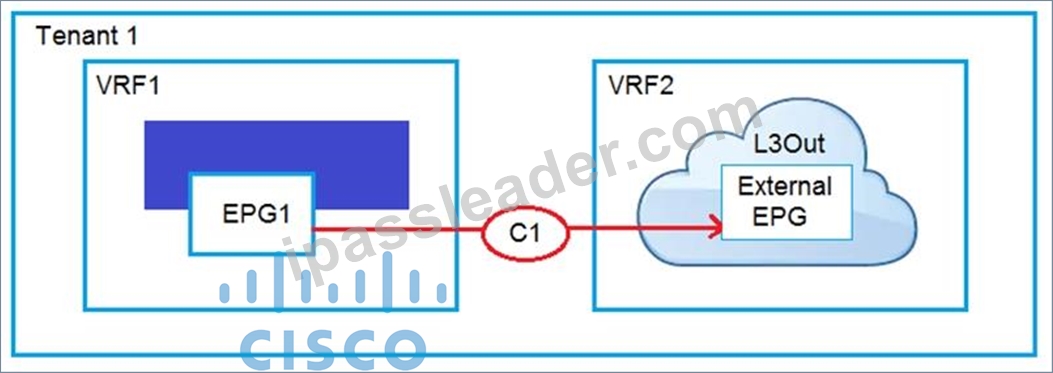
An engineer must have communication between EPG1 in VRF1 and External EPG in VRF2. Which three actions should be taken for the defined subnets in the L3Out External EPG to accomplish this goal? (Choose three.)
- A. Enable Shared Route Control Subnet
- B. Enable External Subnets for External EPG
- C. Enable Aggregate Shared Routes
- D. Enable Export Route Control Subnet
- E. Enable Import Route Control Subnet
- F. Enable Shared Security Import Subnet
Answer: D,E,F
NEW QUESTION # 71
Refer to the exhibit. Which three actions should be taken to implement the vPC in the Cisco ACI fabric? (Choose three.)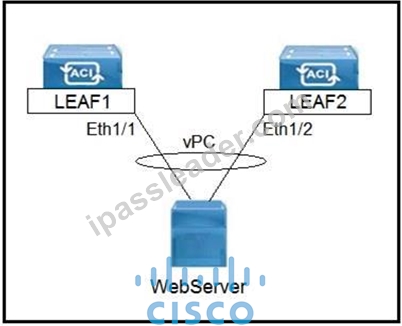
- A. Select common switch profiles
- B. Select individual interface profiles
- C. Select common interface profiles
- D. Select individual switch profiles
- E. Select a common vPC interface policy group
Answer: B,D,E
NEW QUESTION # 72
An organization expands a Cisco ACI Multi-Pod from two to six pods and must ensure that the control plane scales. What should be configured in the IPN to ensure that BUM traffic is forwarded efficiently across the IPN?
- A. BIDIR-PIM
- B. spine headend replication
- C. MSDP
- D. MP-BGP
Answer: A
NEW QUESTION # 73
Which action should be taken in Cisco ACI to reassign a unique globally scoped pcTag to an EPG that provides a global contract?
- A. Configure subnets that are treated as virtual IP
- B. Configure subnets that are shared between VRFs
- C. Configure subnets that advertise externally
- D. Configure subnets that are private to VRF
Answer: B
Explanation:
In Cisco ACI, to reassign a unique globally scoped pcTag to an Endpoint Group (EPG) that provides a global contract, one should configure subnets that are shared between VRFs (Virtual Routing and Forwarding instances) (Option C). This action allows subnets associated with an EPG to be shared across different VRFs while maintaining unique identifiers for application endpoint groups within the global scope of the fabric.
References := ( Implementing Cisco Application Centric Infrastructure Official Cert Guide )
NEW QUESTION # 74
A customer plans to deploy a Cisco ACI Multi-Pod deployment. Which two features must be implemented on the IPN switches?
- A. Configure PIM anycast RP.
Configure a minimum multicast range of /23. - B. Configure PIM anycast RP.
Configure a maximum multicast range of /15. - C. Enable BIDIR-PIM.
Configure a maximum multicast range of /23. - D. Enable BIDIR-PIM.
Configure a minimum multicast range of /15.
Answer: A
NEW QUESTION # 75
The servers are dual-homed to Cisco ACI Leaf1001 and Leaf1002 and must be connected in an active-active mode. The server NICs do not support LACP. These settings have already been configured on the Cisco ACI:
- interface policy group type Leaf Access Port named active-active-
noLACP
- three port selectors: port-1, port-2, and port-3
- AEP called active-active-noLACP has three associated EPGs: EPG-A,
EPG-B, and EPG-C
Which action must be taken to migrate the server ports to a different leaf switch in the event of a catastrophic failure?
- A. Configure failover VLANs in the VLAN pool.
- B. Enable Port Tracking under System Settings.
- C. Enable IP Data Plane Learning.
- D. Configure the AEP on a physical domain.
Answer: B
NEW QUESTION # 76
An engineer configures a new Cisco ACI Multi-Site Orchestrator node to join an MSO cluster. Which two components are necessary to ensure that the new node has IP connectivity in this configuration? (Choose two.)
- A. Cisco ACI spine interfaces that are connected to ISN
- B. management IP of ESXi hosts where the controllers are deployed
- C. OOB interface of ISN
- D. Cisco APICs over the OOB management network
- E. existing Cisco ACI Multi-Site Orchestrator node
Answer: D,E
NEW QUESTION # 77
A leaf receives unicast traffic that is destined to an unknown source, and spine proxy is enabled in the corresponding bridge domain. Drag and drop the Cisco ACI forwarding operations from the left into the order the operation occurs on the right.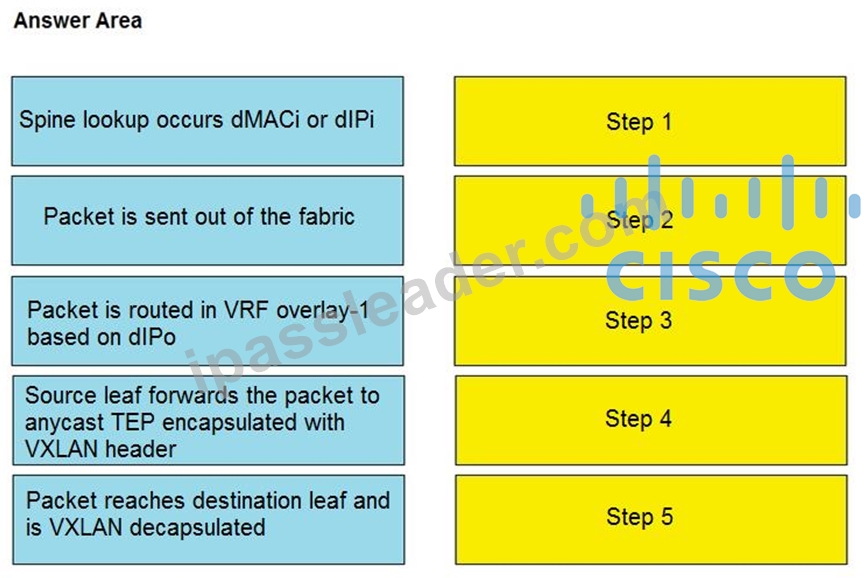
Answer:
Explanation: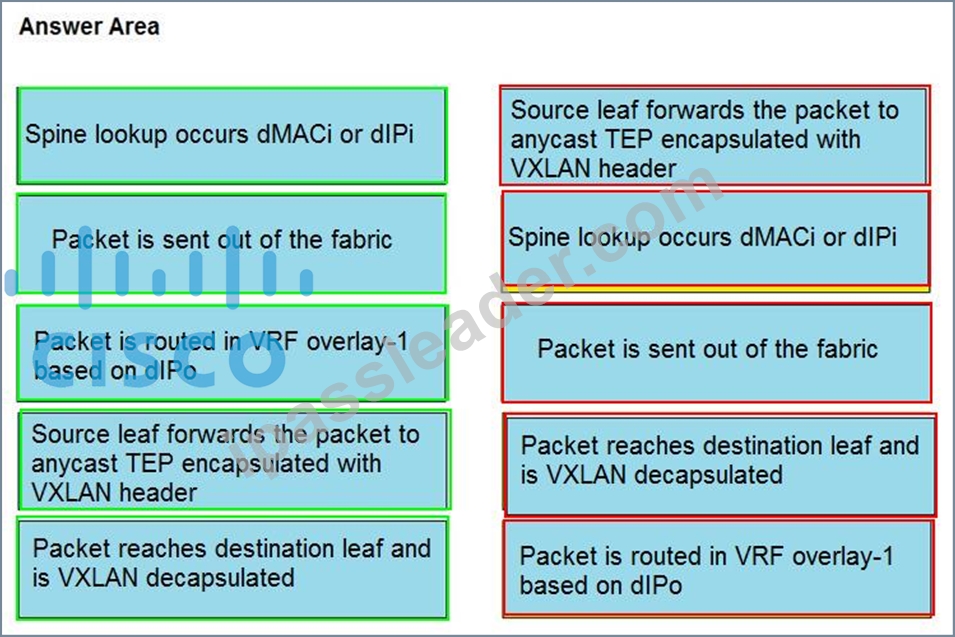
NEW QUESTION # 78
Drag and Drop Question
Drag and drop the tenant implementation designs from the left onto the outcomes of the design when a greenfield Cisco ACI fabric is deployed on the right.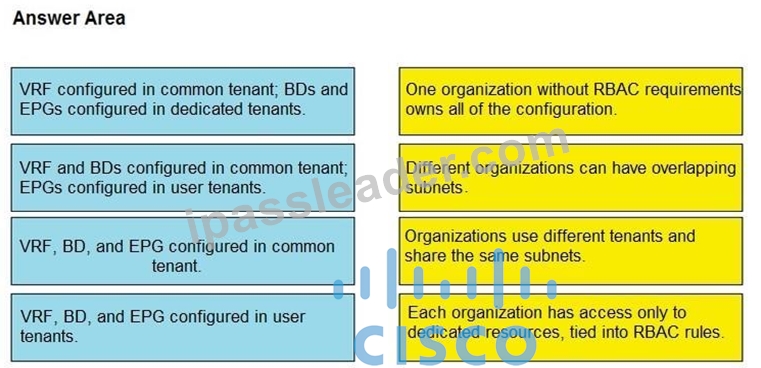
Answer:
Explanation: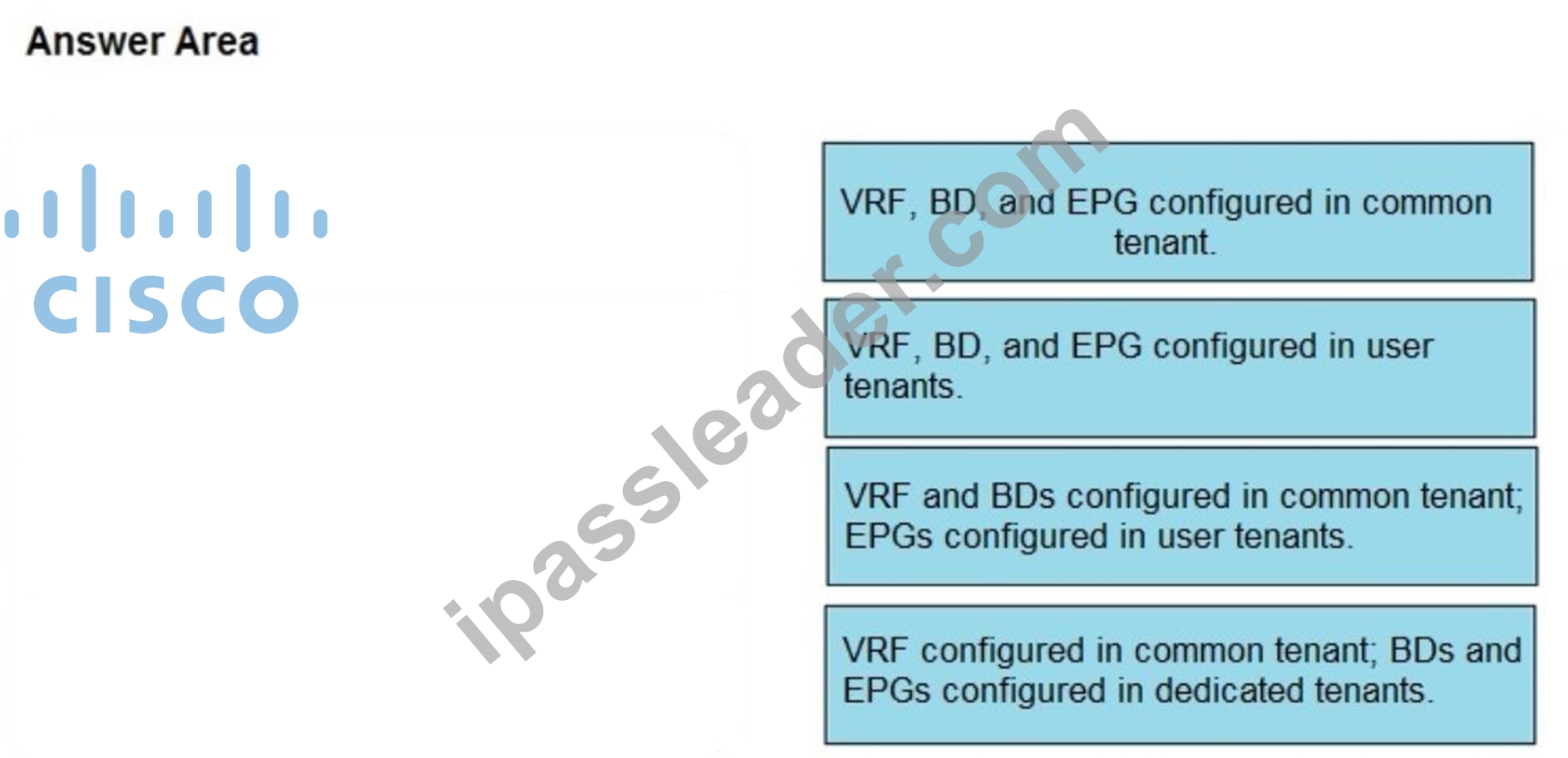
NEW QUESTION # 79
In a Cisco ACI Multi-Site fabric, the Inter-Site BUM Traffic Allow option is enabled in a specific stretched bridge domain. What is used to forward BUM traffic to all endpoints in the same broadcast domain?
- A. egress replication on the destination leaf switches
- B. ingress replication on the spines in the source site
- C. egress replication on the source leaf switches
- D. ingress replication on the spines in the destination site
Answer: D
NEW QUESTION # 80
What is a characteristic of application-centric design in Cisco ACI?
- A. It simplifies gradual migration from a traditional network.
- B. One-to-one mapping between EPGs and bridge domains Is enforced.
- C. EPGs represent different application tiers.
- D. A bridge domain has only one subnet.
Answer: C
Explanation:
An application-centric design in Cisco ACI focuses on the application requirements and interactions between different application components. In this design, EPGs (Endpoint Groups) represent different application tiers, such as web, application, and database tiers. This approach allows for a more flexible and scalable network configuration that aligns with the application architecture, enabling policies to be applied based on the application's needs rather than the network topology. References := Implementing Cisco Application Centric Infrastructure Official Cert Guide
NEW QUESTION # 81
An engineer must implement an L30ut within a tenant to allow the reachability to services outside of the Cisco ACI fabric. The requirement is to allow communication from the EPGs in the same VRF to the external services and save TCAM resource utilization. Which contract insertion method must be used to meet these requirements?
- A. Provider: each service EPGs Consumer: vzAny inside the VRF
- B. Provider: L30ut external EPGs Consumer: each service EPGs
- C. Provider: L30ut external EPGs Consumer: vzAny inside VRF
- D. Provider: each service EPGs Consumer: L30ut external EPGs
Answer: C
Explanation:
To allow reachability to services outside of the Cisco ACI fabric while conserving TCAM resources, an engineer should use a contract insertion method where L30ut external EPGsact as providers and vzAny inside VRF acts as consumers. This configuration allows for communication from all EPGs within a VRF (represented by vzAny) to access external services through L30ut without having to create individual contracts for each service EPG, thus saving TCAM resources. References: Implementing Cisco Application Centric Infrastructure Official Cert Guide
NEW QUESTION # 82
Refer to the exhibit. An engineer is deploying a Cisco ACI Multi-Pod with an independent active/active Layer 3 firewall cluster across the pods. Which task must the engineer perform to prevent the creation of duplicate IP/MAC entries across the pods?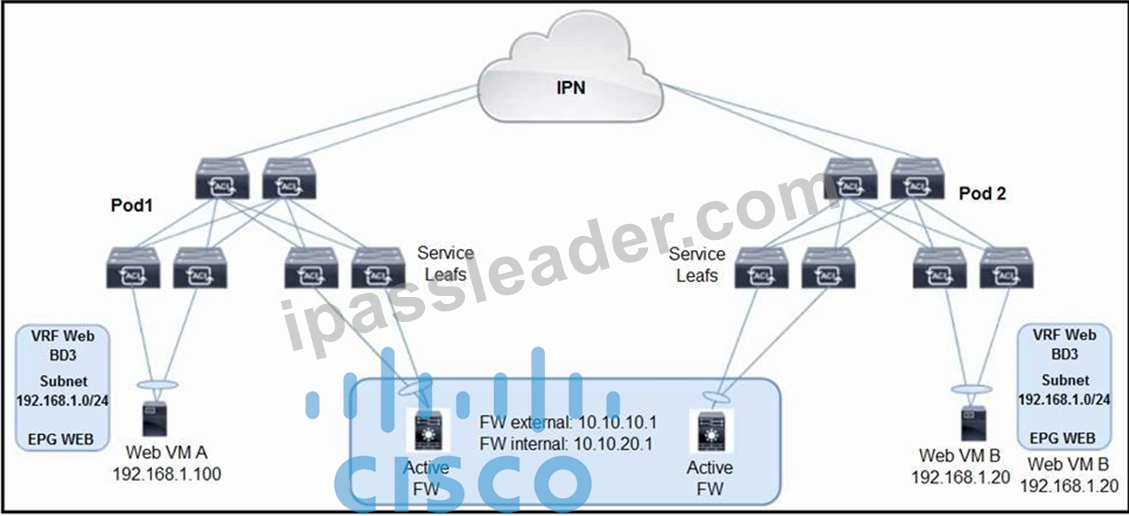
- A. Disable Limit IP Learning to Subnet.
- B. Configure the subnet as shared.
- C. Configure anycast service.
- D. Enable Host Route Advertisement.
Answer: C
NEW QUESTION # 83
Refer to the exhibit. A customer implements Cisco ACI Multi-Site with default MTU settings between two sites. Which configuration should be applied on the interface Eth1/10 on the ISN-1 device?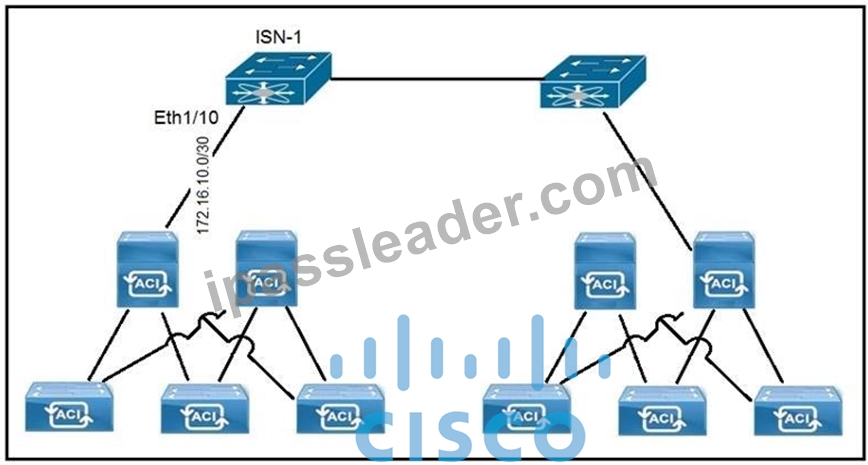
- A.
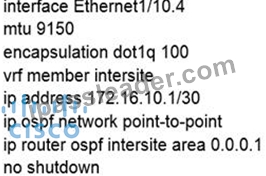
- B.
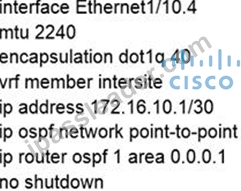
- C.
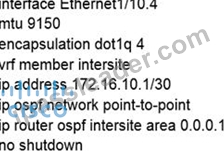
- D.
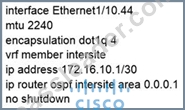
Answer: C
NEW QUESTION # 84
What is the outer destination IP address in the VXLAN encapsulated packet for Layer 2 Broadcast, Unknown-unicast and Multicast (BUM) that is sent between two Cisco ACI sites?
- A. Multi-Pod Data-Plane TEP
- B. Overlay Multicast TEP
- C. MP-BGP EVPN Router-ID
- D. Overlay Unicast TEP
Answer: B
NEW QUESTION # 85
......
Grab latest Cisco 300-630 Dumps as PDF Updated: https://www.ipassleader.com/Cisco/300-630-practice-exam-dumps.html
Newly Released 300-630 Dumps for CCNP Data Center Certified: https://drive.google.com/open?id=1u8TpEezz-UUIXnSTyoLcCFGR4r7PIt9y