

[Mar 15, 2026] 200-301 PDF Recently Updated Questions Dumps to Improve Exam Score
200-301 Dumps Full Questions with Free PDF Questions to Pass
Cisco 200-301, also known as the Cisco Certified Network Associate (CCNA) certification exam, is a popular and highly respected IT certification exam. Cisco Certified Network Associate Exam certification is designed to validate the skills and knowledge of professionals who are seeking to build a career in networking or IT. 200-301 exam covers a broad range of topics related to networking, including network fundamentals, network access, IP connectivity, IP services, security fundamentals, and automation and programmability.
Cisco 200-301 exam is an excellent opportunity for network engineers to validate their skills and knowledge in the networking field. It is a globally recognized certification, and it opens up many career opportunities in the networking industry. With the right training and preparation, passing 200-301 exam can be an achievable goal for anyone who is passionate about networking.
NEW QUESTION # 143
Refer to the exhibit.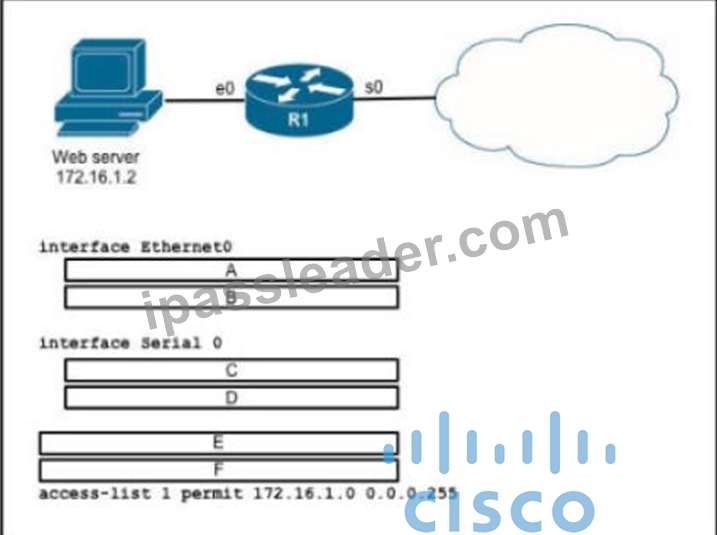
An engineer is configuring the router to provide static NAT for the webserver Drag and drop the configuration commands from the left onto the letters that correspond to its position in the configuration on the right.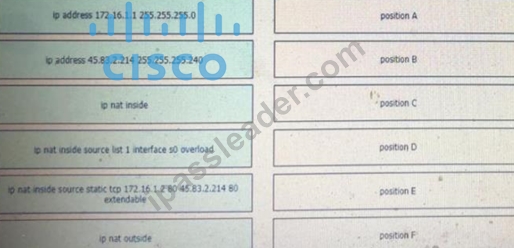
Answer:
Explanation: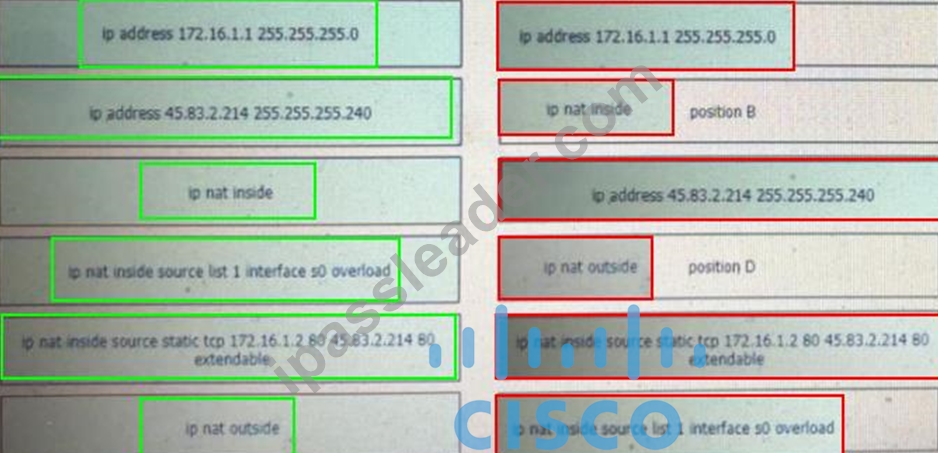
NEW QUESTION # 144
Which two task should you perform to begin troubleshooting a network problem? (choose two)
- A. Implement an action plan
- B. Monitor and verify the resolution
- C. Gather all the facts
- D. Define the problem as a set of symptoms and causes
- E. Analyze the resu
Answer: C,D
NEW QUESTION # 145
An engineer is configuring switch SW1 to act an NTP server when all upstream NTP server connectivity fails. Which configuration must be used?
- A. SW1# config t
SW1(config)#ntp server192.168.1.1
SW1(config)#ntp access-group peer accesslist1 - B. SW1# config t
SW1(config)#ntp peer 192.168.1.1
SW1(config)#ntp access-group peer accesslist1 - C. SW1# config t
SW1(config)#ntp master
SW1(config)#ntp server192.168.1.1 - D. SW1# config t
SW1(config)#ntp backup
SW1(config)#ntp server192.168.1.1
Answer: C
Explanation:
The "NTP Master" command sets this device (SW1) as an NTP server, the second command
"NTP server 192.168.1.1" synchronises this device to 192.168.1.1's time. if the upstream connectivity to 192.168.1.1 is lost, this device will continue to act as a NTP server for the rest of the hosts in the network.
NEW QUESTION # 146
Drag and drop the WLAN components from the left onto the component details on the right.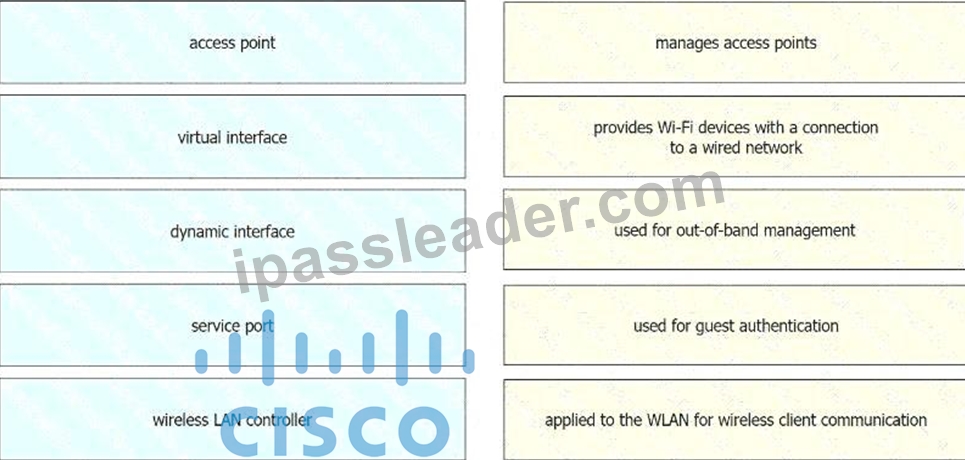
Answer:
Explanation: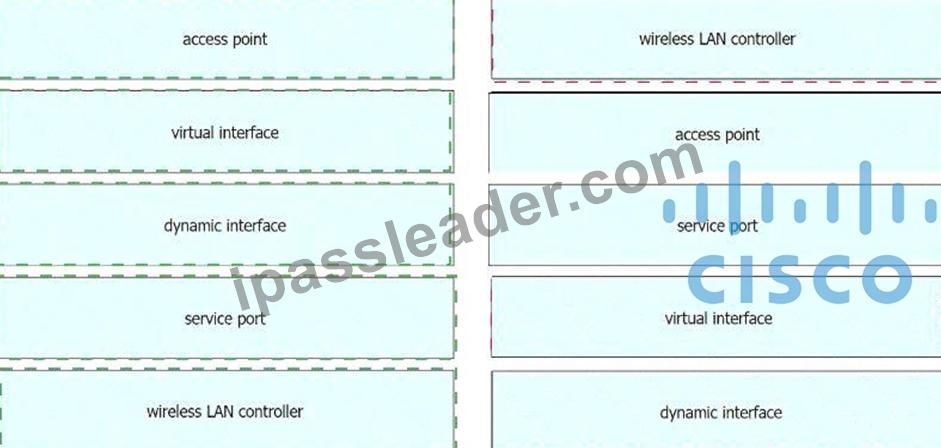
Explanation: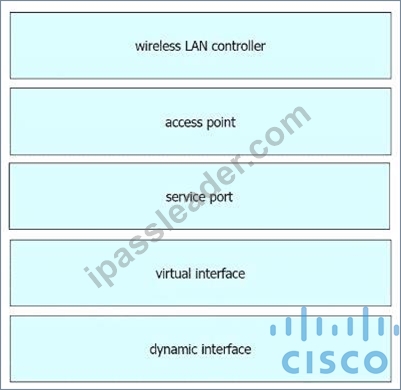
NEW QUESTION # 147
Drag and drop the TCP or UDP details from the left onto their corresponding protocols on the right.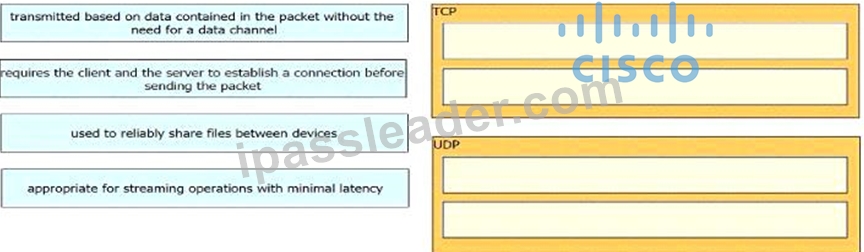
Answer:
Explanation: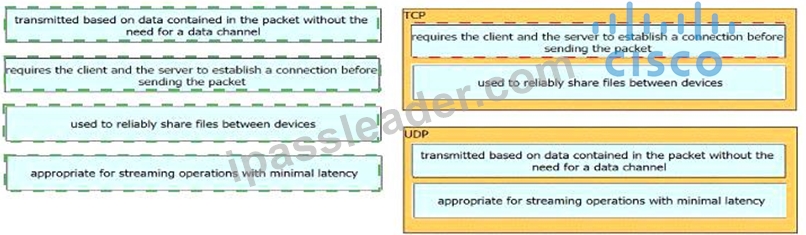
Explanation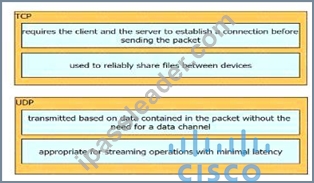
NEW QUESTION # 148
Refer to the exhibit. A packet sourced from 172.18.33.2 is destined for 172.18.32.38.
Where does the router forward the packet?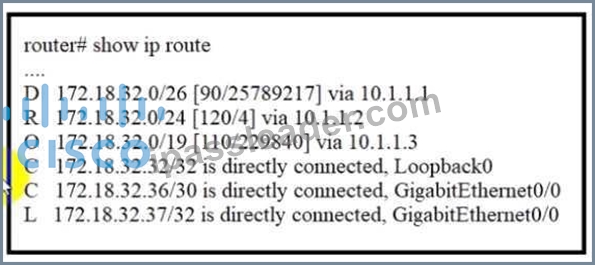
- A. GigabitEthernet0/0
- B. 10.1.1.1
- C. Loopback0
- D. 10.1.1.3
Answer: C
NEW QUESTION # 149 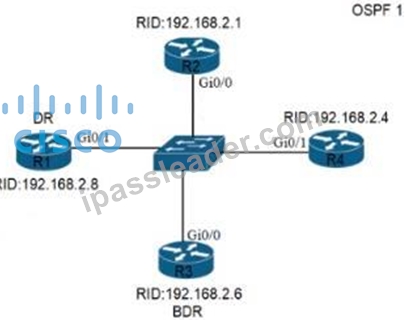
Refer to the exhibit. All routers in the network are configured R2 must be the DR. After the engineer connected the devices, R1 was elected as the DR. Which command sequence must be configure on R2 to Be elected as the DR in the network?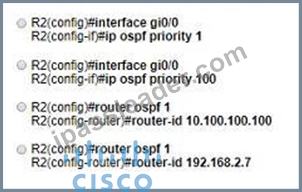
- A. Option C
- B. Option D
- C. Option B
- D. Option A
Answer: C
NEW QUESTION # 150
Drag and drop the Ansible features from the left to the right Not all features are used.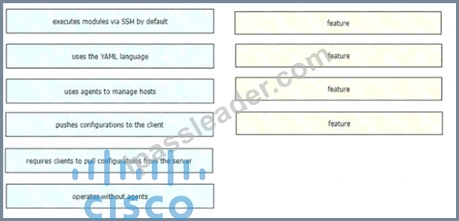
Answer:
Explanation: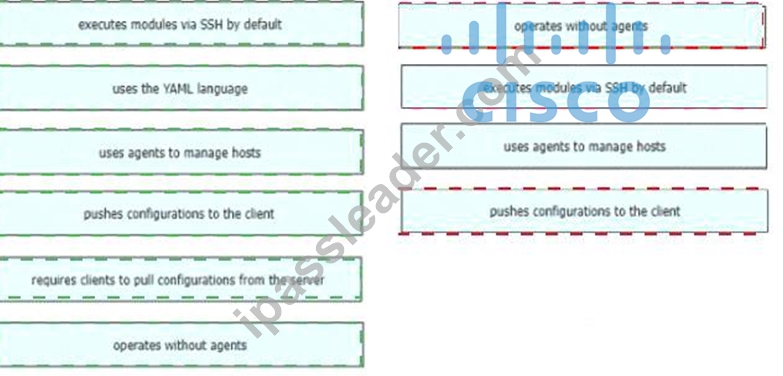
Explanation: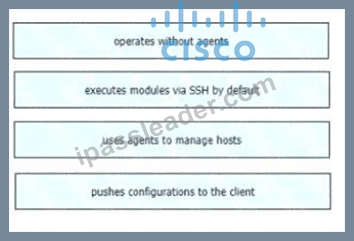
NEW QUESTION # 151
Physical connectivity is implemented between the two Layer 2 switches, and the network connectivity between them must be configured
1. Configure an LACP EtherChannel and number it as 1; configure it between switches SW1 and SVV2 using interfaces Ethernet0/0 and Ethernet0/1 on both sides. The LACP mode must match on both ends
2 Configure the EtherChannel as a trunk link.
3. Configure the trunk link with 802.1 q tags.
4. Configure the native VLAN of the EtherChannel as VLAN 15.
Answer:
Explanation:
Answer as below configuration:
On SW1:
conf terminal
vlan 15
exit
interface range eth0/0 - 1
channel-group 1 mode active
exit
interface port-channel 1
switchport trunk encapsulation dot1q
switchport mode trunk
switchport trunk native vlan 15
end
copy run start
on SW2:
conf terminal
vlan 15
exit
interface range eth0/0 - 1
channel-group 1 mode active
exit
interface port-channel 1
switchport trunk encapsulation dot1q
switchport mode trunk
switchport trunk native vlan 15
end
copy run start
NEW QUESTION # 152
Refer to the exhibit.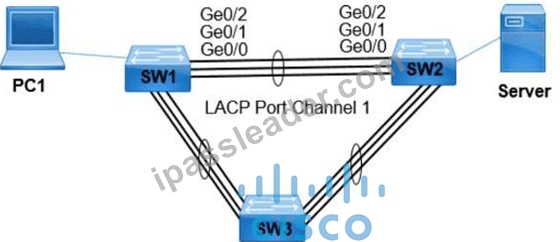
PC1 regularly sends 1800 Mbps of traffic to the server. A network engineer needs to configure the EtherChannel to disable Port Channel 1 between SW1 and SW2 when the Ge0/0 and Ge0/1 ports on SW2 go down. Which configuration must the engineer apply to the switch?
- A.
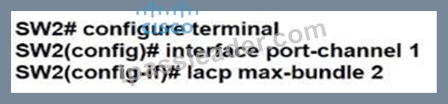
- B.

- C.

- D.
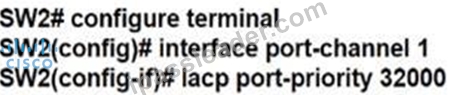
Answer: B
NEW QUESTION # 153
Refer to the exhibit.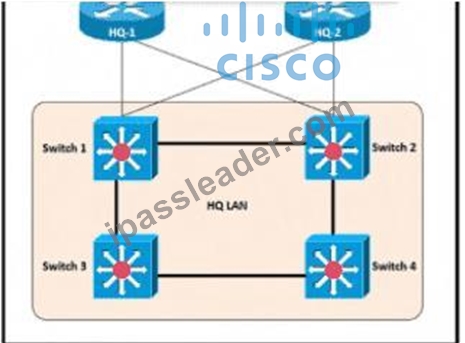
After the election process what is the root bridge in the HQ LAN?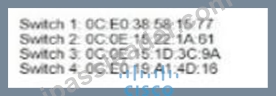
- A. Switch 2
- B. Switch 4
- C. Switch 1
- D. Switch 3
Answer: D
Explanation:
The root bridge is determined by the lowest bridge ID, which consists of the priority value and the MAC address. Because the priority values of all of the switches are not avalable, the MAC address is used to determine the root bridge. Because S3 has the lowest MAC address, S3 becomes the root bridge.
NEW QUESTION # 154
Drag and drop the network protocols from the left onto the correct transport services on the right.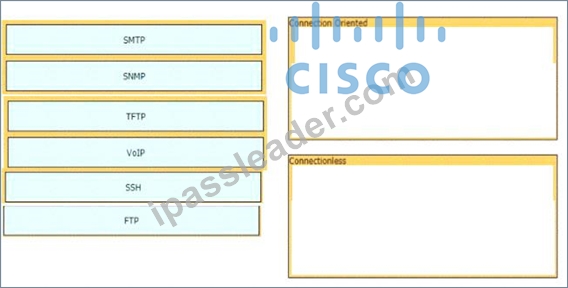
Answer:
Explanation: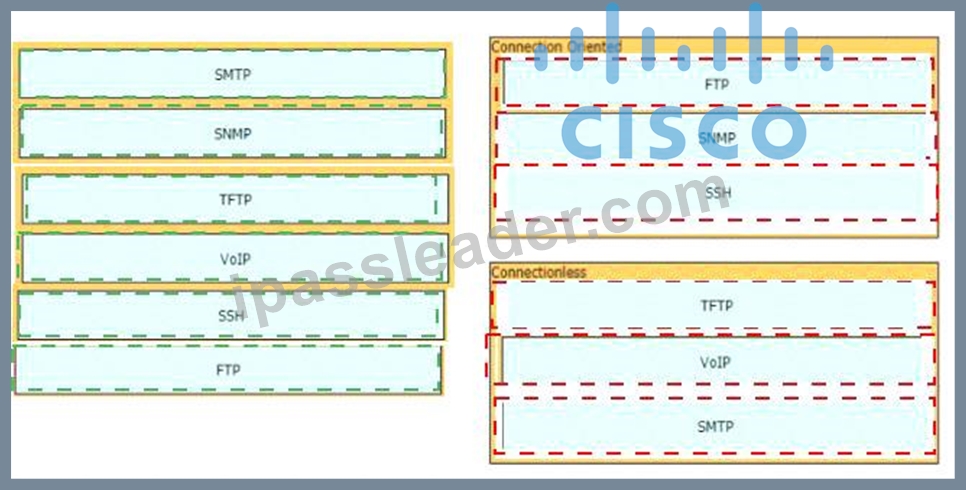
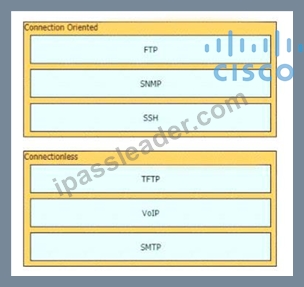
NEW QUESTION # 155
Drag and Drop Question
Drag and drop the IPv4 network subnets from the left onto the correct usable host ranges on the right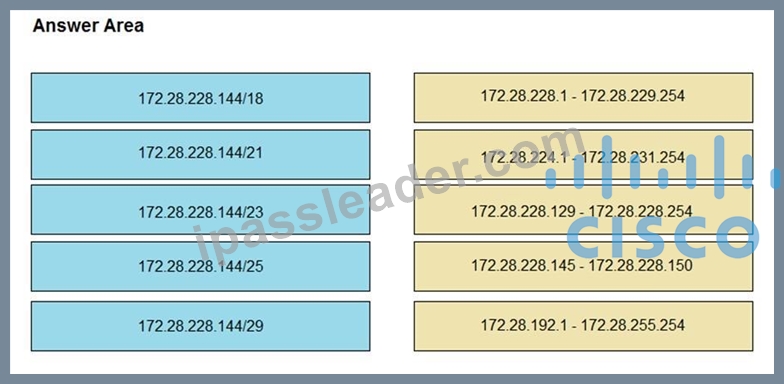
Answer:
Explanation: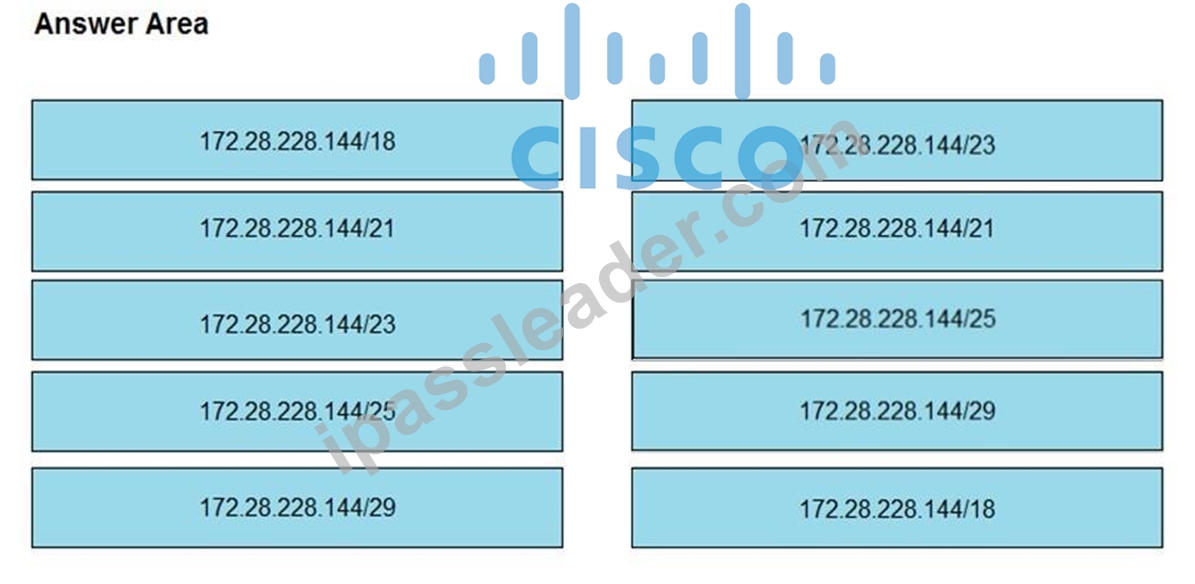
Explanation:
This subnet question requires us to grasp how to subnet very well. To quickly find out the subnet range, we have to find out the increment and the network address of each subnet. Let's take an example with the subnet 172.28.228.144/18:
From the /18 (= 1100 0000 in the 3rd octet), we find out the increment is 64. Therefore the network address of this subnet must be the greatest multiple of the increment but not greater than the value in the 3rd octet (228). We can find out the 3rd octet of the network address is 192 (because 192 = 64 * 3 and 192 < 228) -> The network address is 172.28.192.0. So the first usable host should be 172.28.192.1 and it matches with the 5th answer on the right. In this case we don't need to calculate the broadcast address because we found the correct answer.
Let's take another example with subnet 172.28.228.144/23 -> The increment is 2 (as /23 = 1111
1110 in 3rd octet) -> The 3rd octet of the network address is 228 (because 228 is the multiply of 2 and equal to the 3rd octet) -> The network address is 172.28.228.0 -> The first usable host is
172.28.228.1. It is not necessary but if we want to find out the broadcast address of this subnet, we can find out the next network address, which is 172.28.(228 + the increment number).0 or
172.28.230.0 then reduce 1 bit -> 172.28.229.255 is the broadcast address of our subnet.
Therefore the last usable host is 172.28.229.254.
NEW QUESTION # 156
Which command automatically generates an IPv6 address from a specified IPv6 prefix and MAC address of an interface?
- A. ipv6 address 2001:DB8:5:112::/64 eui-64
- B. ipv6 address 2001:DB8:5:112::2/64 link-local
- C. ipv6 address dhcp
- D. ipv6 address autoconfig
Answer: D
Explanation:
The "ipv6 address autoconfig" command causes the device to perform IPv6 stateless address autoconfiguration to discover prefixes on the link and then to add the EUI-64 based addresses to the interface. Addresses are configured depending on the prefixes received in Router Advertisement (RA) messages. The device will listen for RA messages which are transmitted periodically from the router (DHCP Server). This RA message allows a host to create a global IPv6 address from: + Its interface identifier (EUI-64 address) + Link Prefix (obtained via RA) Note: Global address is the combination of Link Prefix and EUI-64 address
NEW QUESTION # 157
Refer to the exhibit.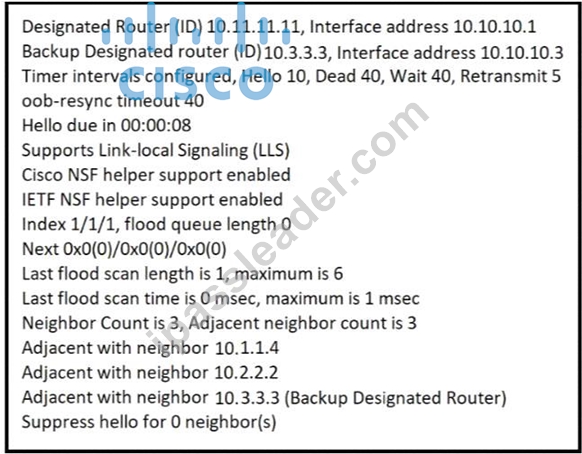
The show ip ospf interface command has been executed on R1 How is OSPF configured?
- A. The default Hello and Dead timers are in use
- B. There are six OSPF neighbors on this interface
- C. A point-to-point network type is configured
- D. The interface is not participating in OSPF
Answer: A
NEW QUESTION # 158
......
100% Updated Cisco 200-301 Enterprise PDF Dumps: https://www.ipassleader.com/Cisco/200-301-practice-exam-dumps.html
Free CCNA 200-301 Official Cert Guide PDF Download: https://drive.google.com/open?id=1cTBmKA3TZWXCv3s_IazNw8M7-ynSYhqK